Deciding what materials can be reused and what can be disposed of is a tricky task, even for cells. In a study published today in Nature Cell Biology, University of Basel researchers discovered a cellular machine called FERARI that sorts out usable proteins for recycling. The paper explains how FERARI works and why it is so special.
Recycling is important because it saves energy and resources. Inside cells, tiny organelles called endosomes separate the delivered cellular material into reusable material and waste. However, how exactly the endosomes sort the material has not been fully understood.
The new research suggests that FERARI is a key player in this process. FERARI distributes the recyclable molecules (mainly transport proteins and receptors) and reintroduces them into the cellular cycle. In this way, valuable cell components do not have to be constantly produced anew, which saves not only energy but also time.
Endosomes are small membrane-bound vesicles inside animal and plant cells. During their maturation, endosomes pass through various stages in which they carry out different tasks. The early endosomes mainly absorb material, the more mature ones sort out the recyclable material, and the late endosomes dispose of the non-reusable residual waste.
Search Antibodies Search Now Use our Antibody Search Tool to find the right antibody for your research. Filter
by Type, Application, Reactivity, Host, Clonality, Conjugate/Tag, and Isotype.
In the sorting endosomes, the researchers have now demonstrated that FERARI acts as a kind of distribution platform. “FERARI consists of different proteins and is responsible for ensuring that vesicles, used for recycling, dock onto the sorting endosomes and can be loaded with reusable material,” Spang explains.
The special feature of FERARI is that it coordinates both the fusion of the endosome with the recycling vesicle (the kiss) as well as the pinching off of the recycling vesicle after it has been loaded with the cargo (the run). The loaded vesicles then transport their cargo to the site of action, the cell membrane.
“Our work contradicts the current thinking which assumes that all recycling vesicles are pinched off directly from the endosome,” says Spang. “We are the first to show this kind of ‘kiss-and-run’ mechanism.”
Finally, if FERARI does not work properly, recycling in the cell is impaired. Disorders in cellular transport and recycling processes can lead to a variety of diseases, including cancer, metabolic diseases, and neurodegenerative diseases.
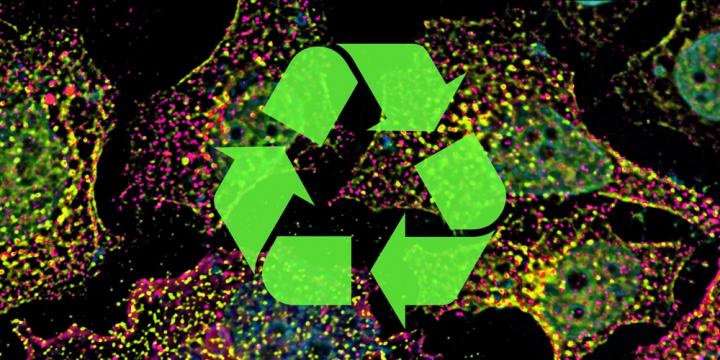
Image: Sorting endosomes (green) and recycling vesicles (magenta) in human cells. Image courtesy of Biozentrum, University of Basel.