In 2018, 1.7 million people died from lung cancer worldwide—a number equivalent to the population of Barcelona. The high mortality rate of lung cancer reflects the need for the development of treatments that are more efficient.
A study headed by Ángel R. Nebreda of IRB Barcelona was published yesterday in the journal PNAS. The study demonstrates that the protein p38 is one of the key elements supporting lung cancer growth. In particular, the study focuses on cells expressing the oncogene Kras, which causes the transformation of a healthy cell into a cancer cell. Mutations in Kras are responsible for approximately 25% of lung cancer cases.
Search Antibodies Search Now Use our Antibody Search Tool to find the right antibody for your research. Filter
by Type, Application, Reactivity, Host, Clonality, Conjugate/Tag, and Isotype.
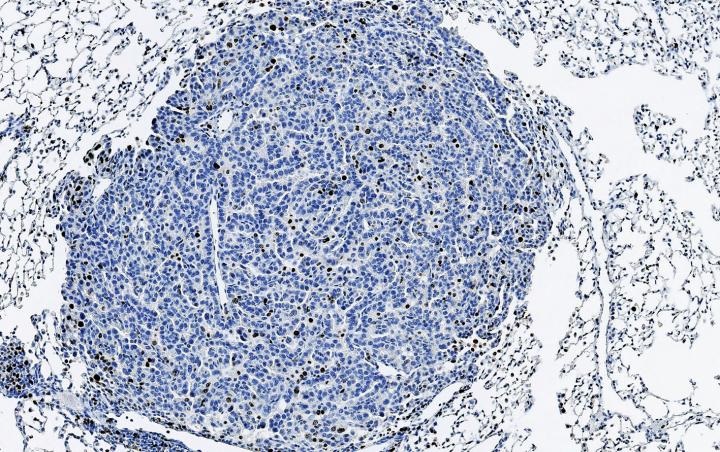
For this study, the scientists used genetic mouse models with the KrasG12V mutation that develop lung tumors. Using these models, they observed that p38 inhibition leads to a dramatic reduction in tumor growth and aggressiveness. Furthermore, complementary studies performed with information deposited in cancer genome databases indicate that the patients with lower levels of p38 in tumors have a more favorable prognosis. This function of p38 is related to the production of factors that stimulate cancer cell division and thus enhance tumor growth.
According to first author Jessica Vitos, the work “shows how tumors exploit a protein, which in principle protects healthy lung cells, for their own progression.”
Additionally, the results may be useful for therapeutic applications. Chemical compounds that inhibit p38 function would interfere with the growth of lung cancer cells,” Vitos says.
Image: Lung tumor stained for proliferating cells (brown). Image courtesy of IRB Barcelona.