Researchers at University of California San Diego School of Medicine have discovered how a new immune system works to protect bacteria from bacteriophages. This new system is unusual in that it works by abortive infection—the infected bacterial cell self-destructs to keep the infection from spreading to other cells.
A pair of papers, published today in Molecular Cell, provides new information that could be employed to improve treatment of multidrug-resistant bacterial infections by refining phage therapy or even purposefully triggering bacterial self-destruction.
"Abortive infection is an old concept, but it's still controversial—a bacterial cell essentially takes one for the team, killing itself rather than being used to produce more phages," said senior author Kevin Corbett. "It's been debated whether or not it's logical, from an evolutionary standpoint, for single-celled organisms to do this. But if we think of bacteria as a cooperative community, a biofilm, rather than as individual cells, it makes sense."
Search Antibodies Search Now Use our Antibody Search Tool to find the right antibody for your research. Filter
by Type, Application, Reactivity, Host, Clonality, Conjugate/Tag, and Isotype.
Almost 75,000 different bacteria have had their genomes sequenced. Of those, Corbett said this new defense system is found in approximately 10 percent. His team cloned the system, now called CBASS, into a laboratory strain of E. coli that is usually sensitive to phage infection. "We were thrilled to find that CBASS provided nearly absolute immunity to phages," Corbett said.
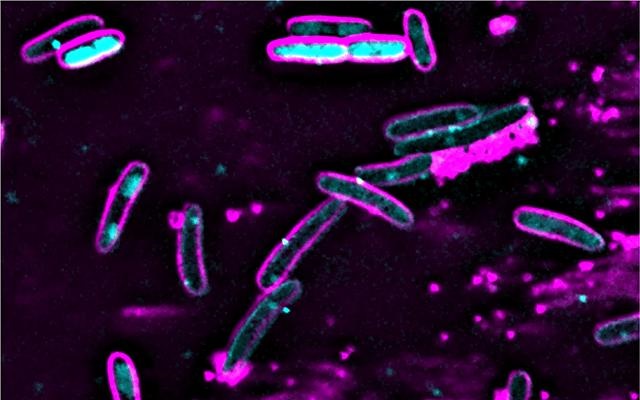
Digging deeper, the team went on to unravel a number of biochemical and structural details about the CBASS defense system, which contains several proteins. They found that the HORMA proteins sense the infection, then stimulate a second protein to synthesize a second messenger molecule. This molecule in turn activates a nuclease enzyme that destroys the bacterium's own genome, killing the cell and also keeping the phage from replicating and infecting other cells.
After falling out of favor a century ago, phages are once again being explored as a therapy for multidrug-resistant bacterial infections. According to Corbett, researchers might be able to use this new mechanistic information on bacterial immune systems to fine-tune phages to evade these systems, making phage therapies more effective.
Image: E. coli cells containing the CBASS system (pink oval shapes) destroy their own genomes (blue) after infection with bacteriophage lambda. Uninfected cells with intact genomes can be seen at the top of the image. The small blue dots are bacteriophage particles, and the pink background staining is debris from dead and dying cells. Image courtesy of UC San Diego Health Sciences.