A device to quickly capture and identify various strains of virus has been developed by researchers at Penn State and New York University, who say the new device has applications in agriculture, livestock and human clinical use.
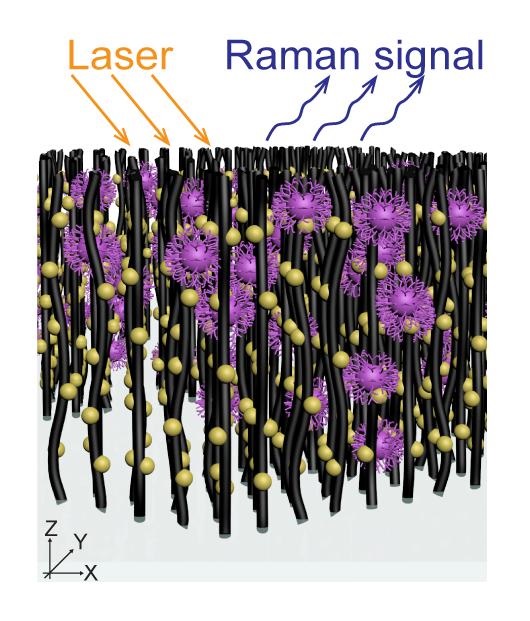
"We have developed a fast and inexpensive handheld device that can capture viruses based on size," said Mauricio Terrones, senior author of a paper published today in PNAS. "Our device uses arrays of nanotubes engineered to be comparable in size to a wide range of viruses. We then use Raman spectroscopy to identify the viruses based on their individual vibration."
This device, called a VIRRION, has a wide range of possible uses. In humans it could facilitate the detection of viruses in minutes rather than in days such as with current methods. Because of its size and low cost, such a device would be useful in every doctor's office as well as in remote locations when disease outbreaks occur, the team explains.
"Most current techniques require large and expensive pieces of equipment," Terrones said. "The VIRRION is a few centimeters across. We add gold nanoparticles to enhance the Raman signal so that we are able to detect the virus molecule in very low concentrations. We then use machine learning techniques to create a library of virus types."
 "The VIRRION enables the rapid enrichment of virus particles from any type of sample, environmental or clinical, which jump-starts viral characterization. This has applications in virus emergence, virus discovery and in diagnosis. Eventually, we hope to use this device for the capture and sequencing of single virions, giving us a much better handle on the evolution of the virus in real time," adds Professor Elodie Ghedin, a virologist at NYU.
Image: An array of nanotubes decorated with gold nanoparticles captures virus molecules, which are then detected in situ using Raman spectroscopy. Image courtesy of Terrones Lab/Penn State.