Axons are the long, thread-like extensions of neurons that send electrical signals to other brain cells. Proper axonal connectivity is vital in order for our brains and bodies to accurately perform all their necessary tasks. In a study published today in Developmental Cell, UNC–Chapel Hill researchers have found a key reason why connectivity goes awry, leading to rare but debilitating neurodevelopmental conditions.
In the study, the researchers show how two gene mutations alter the function of neuronal cilia—the antennae-like protuberances found on many cell types. The resulting dysfunctional cilia affect axonal connectivity, leading to rare Joubert syndrome-related disorders (JSRD).
“Our experiments demonstrate that ciliary signaling facilitates appropriate patterns of axon tract development and connectivity,” says senior author E.S. Anton. “Disrupting ciliary signaling can lead to axonal tract malformations in JSRD.”
Search Antibodies Search Now Use our Antibody Search Tool to find the right antibody for your research. Filter
by Type, Application, Reactivity, Host, Clonality, Conjugate/Tag, and Isotype.
Babies born with dysfunctional cilia and the associated irregular axonal growth and connectivity can develop JSRD. People with this condition may experience developmental delays, intellectual disabilities, abnormal respiratory rhythms, trouble controlling their body movements, and other serious health issues. But how this happens has not been clear.
The team was interested in investigating how cilia become dysfunctional and affect axonal connectivity during brain development. To do so, they used neuron-specific mouse genetic models of two genes called Arl13b and Inpp5 as well as related human mutations from JSRD patients. They also used chemogenetic and optogenetic manipulation of primary cilia signaling.
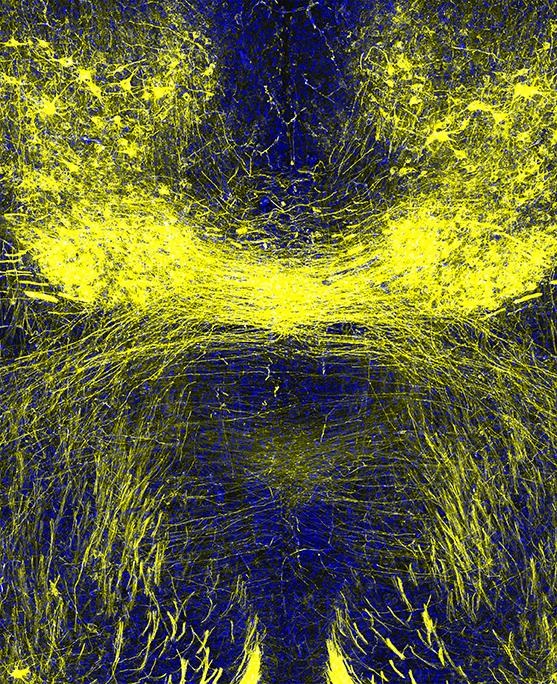
In mice, they found that deletion of Arl13b or Inpp5e impairs the ability of the primary cilium to function as a signaling hub, thus allowing them to examine how cilia-driven signaling regulates axon growth and connectivity in normal and JSRD brains. The team went on to delineate ciliary-driven changes in cell signaling, particularly the ones mediated through major signaling proteins PI3K, AKT, and AC3, effectively modulating axonal behavior.
“By shedding light on the significance of primary cilia in the emergence of brain connectivity, this research helps us understand how cilia dysregulation led to axonal tract defects in Joubert syndrome-related disorders,” Anton says. “Our studies indicate precise manipulation of ciliary signaling in the future may be tested and utilized to alleviate neuronal connectivity defects in ciliopathies such as JSRD.”
Image: The image shows disrupted crisscrossing and organization of axons (yellow) following neuron-specific deletion of primary cilia and Joubert syndrome-related gene, Arl13b. Image courtesy of the Anton lab.