A paper published today in Nature Methods outlines a machine learning-driven technique that predicts how proteins interact with their environment as well as describes a protein's biochemical activity based on surface appearance alone. In addition to deepening our understanding of how proteins function, the method, known as MaSIF (molecular surface interaction fingerprinting), could also support the development of protein-based components for tomorrow's artificial cells, according to a team led by EPFL scientists.
The team took a vast set of protein surface data and fed the chemical and geometric properties into a machine-learning algorithm, training it to match these properties with particular behavior patterns and biochemical activity. They then used the remaining data to test the algorithm. "By scanning the surface of a protein, our method can define a fingerprint, which can then be compared across proteins," says Pablo Gainza, the first author of the study.
Search Antibodies Search Now Use our Antibody Search Tool to find the right antibody for your research. Filter
by Type, Application, Reactivity, Host, Clonality, Conjugate/Tag, and Isotype.
Three prediction challenges are addressed in the paper: protein pocket-ligand prediction, protein–protein interaction site prediction and ultrafast scanning of protein surfaces for prediction of protein–protein complexes.
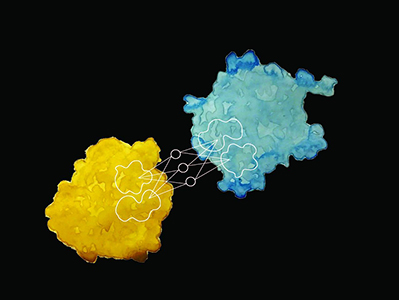
"The algorithm can analyze billions of protein surfaces per second," says senior author Bruno Correia. "Our research has significant implications for artificial protein design, allowing us to program a protein to behave a certain way merely by altering its surface chemical and geometric properties."
Image: Researchers at EPFL have developed a new way to predict a protein's interactions with other proteins and biomolecules, and its biochemical activity, merely by observing its surface. Image courtesy of Laura Persat / 2019 EPFL.