A new mouse study published today in eLife reveals new insights into how certain macrophages can help facilitate the spread of HIV-1. These macrophages—called subcapsular sinus macrophages—are the first layer of cells in the draining lymph node, and they act as a kind of ‘shuttle’ for HIV-1 virus-like particles. These cells help the particles spread by loading them onto two types of immune cells: follicular dendritic cells and B cells.
During HIV-1 infection, follicular dendritic cells act as a reservoir for the virus and an obstacle to curative treatments. However, how these cells initially acquire and preserve HIV-1 has not been well understood. To investigate this, researchers from the National Institute of Allergy and Infectious Diseases visualized the likely early events in the spread of HIV-1 virus-like particles in mice. They looked at how the virus moves from the lymph and blood via sinus-lining macrophages and how it is then transferred to underlying networks of follicular dendritic cells.
Search Antibodies Search Now Use our Antibody Search Tool to find the right antibody for your research. Filter
by Type, Application, Reactivity, Host, Clonality, Conjugate/Tag, and Isotype.
Their work highlighted a subset of lymphoid organ sinus-lining macrophages that provide a cell-to-cell contact portal to shuttle HIV-1 particles onto follicular dendritic and B cells in the lymph node and spleen. They found that a type of protein called MFG-E8 is central to the proper function of this portal, as its absence severely limited the spread of HIV-1 onto follicular dendritic cell networks.
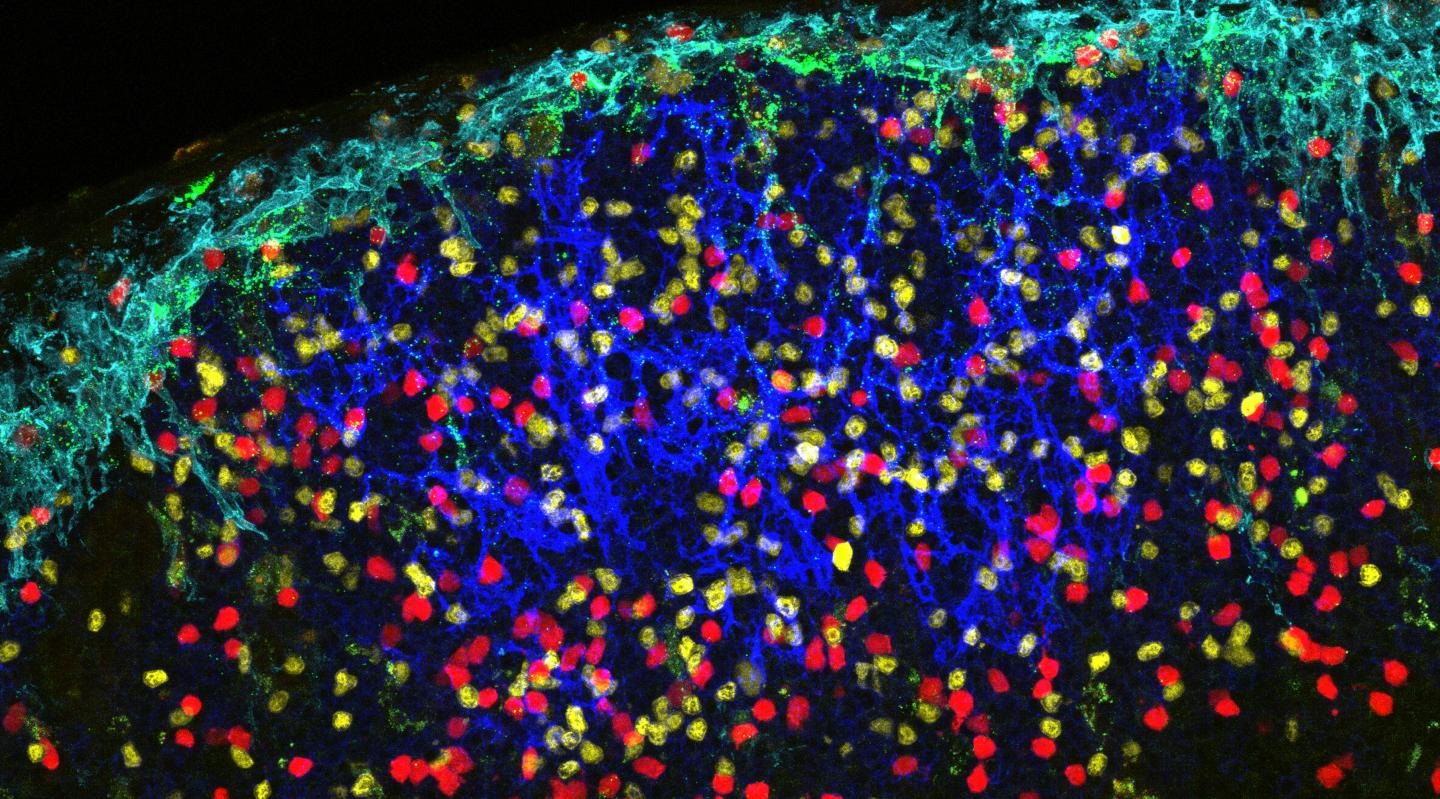
The team also revealed that the HIV-1 envelope, which encloses the viral particle and helps the virus enter cells, provides a means for MFG-E8 binding. MFG-E8 links the HIV-1 particles to αvβ3 integrins expressed on the host’s cells. These integrins help the cell’s uptake of the viral particles, making the particles available to other cell types or (in some instances) targeting them for destruction. The researchers say that further work is now needed to see whether this process involving MFG-E8 works to benefit the host or the virus.
Image: The early event of HIV-1 virus-like particles (shown here in green) spreading in the mouse lymph node. Sinus-lining macrophages (cyan) provide a cell-to-cell contact portal to shuttle HIV-1 particles onto follicular dendritic cells (blue) and HIV-1 reactive B cells (red) in the B cell follicle (marked with wild-type B cells, yellow). Image courtesy of John Kehrl and Chung Park (CC BY 4.0).