Actin filaments are one of the most abundant proteins in all mammalian cells, as they’re an important part of the cytoskeleton and locomotor system. In the nucleus, actin usually occurs as a single protein. It only forms filaments when a signal is given. In a study published yesterday in Nature Communications, University of Freiburg scientists used physiological messengers in cell cultures to study how different signals control the assembly and disassembly of actin filaments in the nucleus.
“It was previously unknown just how a hormone or agent induces the cell to begin filament formation in the intact cell nucleus,” says senior author Robert Grosse. Back in 2013, he discovered that actin threads were formed in the nucleus when he exposed cells to serum components.
Search Antibodies Search Now Use our Antibody Search Tool to find the right antibody for your research. Filter
by Type, Application, Reactivity, Host, Clonality, Conjugate/Tag, and Isotype.
Actin filaments resemble a double chain of beads and create possible anchor points or pathways for the structures in the cell nucleus. For example, they influence DNA’s structure by determining how densely packed the chromatin is, affecting the readability of the genetic material. “What we have here is a generally valid mechanism that shows how external physiological signals can control the cytoskeleton in the nucleus and reorganize the genome in a very short time,” Grosse explains.
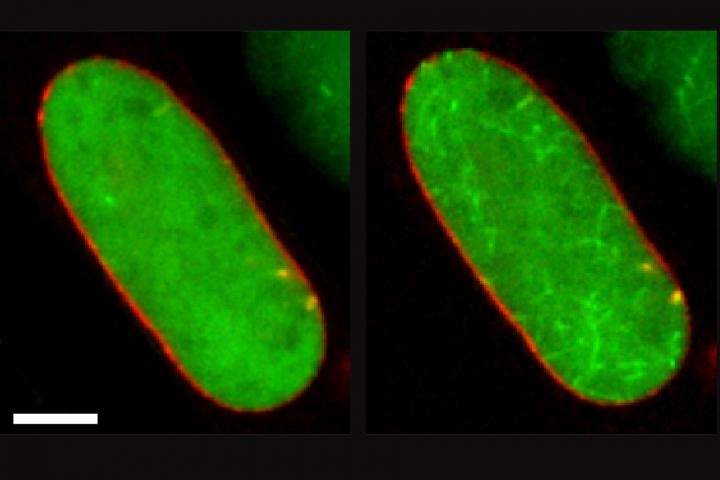
In the study, the team used fluorescence microscopy and genetic engineering methods to show how actin filaments appeared in the nucleus after physiological messengers such as thrombin and LPA bound to G-protein-coupled receptors. These receptors can be bound by agents, hormones, or signal transmitters at the cell membrane and are a target for a large number of clinical drugs.
Grosse is now investigating the more exact processes in the cell nucleus. “My team in Freiburg wants to find out in detail how filament formation influences the readability of the genetic material and what role the inner cell nucleus membrane plays in this process,” he says.
Image: After the cell has been treated with a messenger substance (right), the green actin molecules in the red cell nucleus (left) form actin filaments that structure the genome. Image courtesy of Robert Grosse.