The human immune system has been evolutionarily shaped by the constant battle against infectious pathogens. One of the key adaptations has to do with a group of molecules called HLA proteins, which activate the immune system by presenting it with fragments of pathogens that have entered the body. People with a wide variety of HLA proteins are thus better armed against a larger number of pathogens.
In a study published yesterday in Nature Medicine, researchers investigated the diversity of HLA genes in cancer patients being treated with immune checkpoint inhibitors. This form of immunotherapy activates the body’s own immune cells to enable them to identify and eliminate tumor cells. According to the new study, patients with a wide variety of HLA molecules derive more benefit from this type of therapy. In the future, HLA diversity analysis may become a part of cancer diagnosis in order to offer cancer patients an individually tailored therapy.
Search Antibodies Search Now Use our Antibody Search Tool to find the right antibody for your research. Filter
by Type, Application, Reactivity, Host, Clonality, Conjugate/Tag, and Isotype.
It is advantageous for the immune system to have many different variants of HLA molecules since each variant can bind to several different pathogens or cancer cell protein fragments. The more the HLA molecule variants differ, the more pathogen molecules they can present to the immune system cells. “Pathogens are constantly changing, and the immune system has to adapt to them,” explains coauthor Tobias Lenz of the Max Planck Institute for Evolutionary Biology. “This leads to constant new diversity in immunity genes.”
The team investigated the influence of this naturally occurring HLA diversity has on the effectiveness of anti-cancer immunotherapies. When treating cancer patients with immune checkpoint inhibitors, certain proteins that reduce the immune response are themselves inhibited. Immune cells are then better able to act against the tumor cells. However, not all cancer patients respond to the same degree: This type of therapy conquers the cancer completely in some while having virtually no effect in others.
The researchers have been investigating the link between the HLA diversity of patients and the success of their therapy. Their research now showed that patients with a wider variety of HLA variants respond better to the therapy and survive for longer. “A higher variability of HLA genes increases the chances of the immune system identifying the cancer cells as foreign and combating them,” Lenz says.
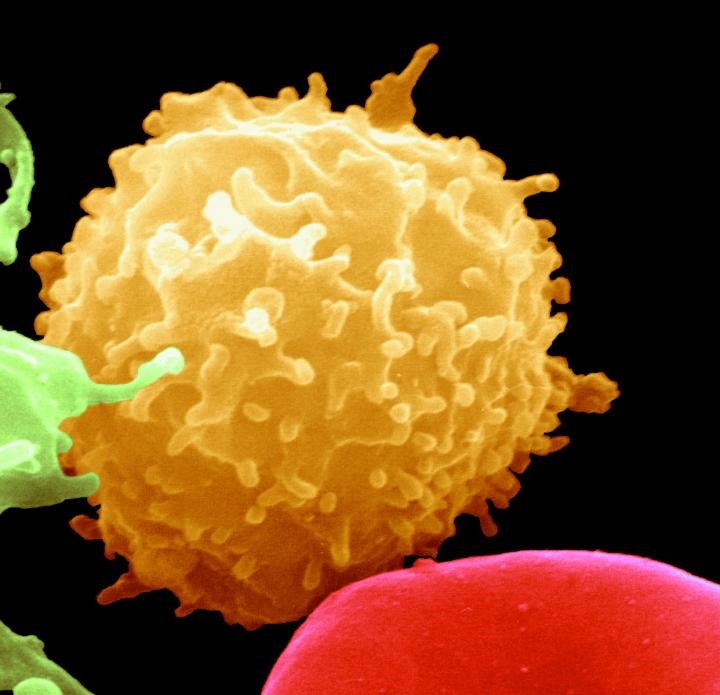
Image: White blood cells like this one detect pathogens and cancer cells. For this, it is important to have a high diversity of so-called HLA genes. Image courtesy of MPI f. Developmental Biology/ Jürgen Berger.