Scientists have designed microscopic swimming ‘donuts’ that mimic biological behavior and could be used for biomedical technologies. The donuts are 3D-printed tori that are coated with nickel and platinum, and they may just bridge the gap between biological and synthetic swimmers. These microswimmers could potentially be used to deliver targeted drugs and to stir samples in labs-on-a-chip. The findings were published today in Nature Communications.
A lab-on-a-chip is a miniature device that mimics a full laboratory on a microchip. According to first author Remmi Danae Baker of Penn State, “It’s really hard to get things to mix when using a lab-on-a-chip. These microtori, because they are active materials and move on their own, could be used to aid in micromixing.”
The researchers manufacture these donuts using a Nanoscribe Photonic Professional GT machine that allows the creation of the 3-, 7-, or 14-micrometer donuts with printed features of up to 200 nanometers. Spider silk is 3–10 micrometers in diameter. The Nanoscribe achieves this using precise laser technology and specially designed photoresists.
Search Antibodies Search Now Use our Antibody Search Tool to find the right antibody for your research. Filter
by Type, Application, Reactivity, Host, Clonality, Conjugate/Tag, and Isotype.
“We create two different designs, horizontal and vertical,” says Baker. “Horizontal tori are printed flat on the supporting glass slide, glazed with nickel and then platinum. Vertical tori are 3D printed upright and are then dipped in nickel and platinum.” The two modes of micro donuts behave differently when transporting particles or active material.
The researchers want the donuts to behave like living organisms—to swim in water and respond to signals. For this experiment, the researchers placed the microtori in a hydrogen peroxide solution, which served as the fuel. Platinum decomposes hydrogen peroxide and powers the propulsion of the donuts.
The nickel serves two purposes. First, platinum will not stick to the plastic micro-donuts, but nickel will and platinum will stick to nickel. Second, nickel is magnetic, so the researchers can manipulate the donuts with magnetic fields.
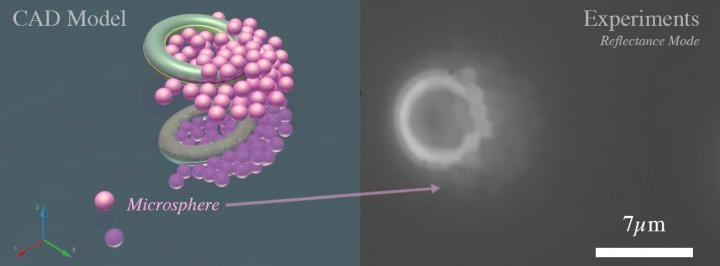
The researchers found a number of new behaviors for these 3D-printed chemically powered microswimmers. Both their experimental and modeling approaches are applicable to other microswimmers powered by alternative methods to hydrogen peroxide. For biological systems, microswimmers might use biocompatible propulsion systems like enzymes or light. According to the researchers, biocompatible microswimmers would be able to “interface and manipulate biological active matter leading to the development of intelligent cell transport and therapy.”
Image: Model of a pair of microtori picking up particles, left. Image of actual microtori picking up particles when a magnetic field is applied, right. Image courtesy of Remmi Danae Baker, Penn State.