Microalgae can form massive assemblages in oceans, attracting many opportunistic organisms that are capable of eliminating the entire algal population within a short time. However, the underlying mechanisms of this watery arms race are largely unknown. In a paper published today in Nature Communications, Max Planck Institute researchers show that a pathogenic fungus alters the metabolism of its algae host to promote its own propagation while preventing the algae’s.
Egg fungi (oomycetes) are known to cause many dangerous diseases in plants and animals, but their relationship with algae is still poorly understood. One hypothesis is that the microorganisms produce chemical signaling substances that regulate the interactions, such as defense, mating, and communication, between living organisms. In order to identify such substances, the scientists established a laboratory system in which oomycetes infect a marine diatom under controlled conditions.
The researchers found that during the infection process, two new substances were formed. Both were so-called carbolines from the class of alkaloids that also includes nicotine and caffeine. Large amounts of these compounds accumulate after oomycete infection.
Search Antibodies Search Now Use our Antibody Search Tool to find the right antibody for your research. Filter
by Type, Application, Reactivity, Host, Clonality, Conjugate/Tag, and Isotype.
“The identity of the substances surprised us, as it has been described in diatoms for the first time and their induction during infection was conserved in the whole population of cells,” explains co-first author Marine Vallet. Interestingly, although these two substances were beneficial to the oomycete, they were ultimately lethal to the algae.
Using high-resolution mass spectrometric methods to separate and identify small substances from complex mixtures, combined with microscopic techniques, scientists were able to identify the active compounds produced by a single algal cell. “One has to bear in mind that a single cell is 30 times smaller than a pinhead and that the concentrations of all substances are very low—to show the chemistry in one single cell is a major technical achievement,” explains senior author Georg Pohnert.
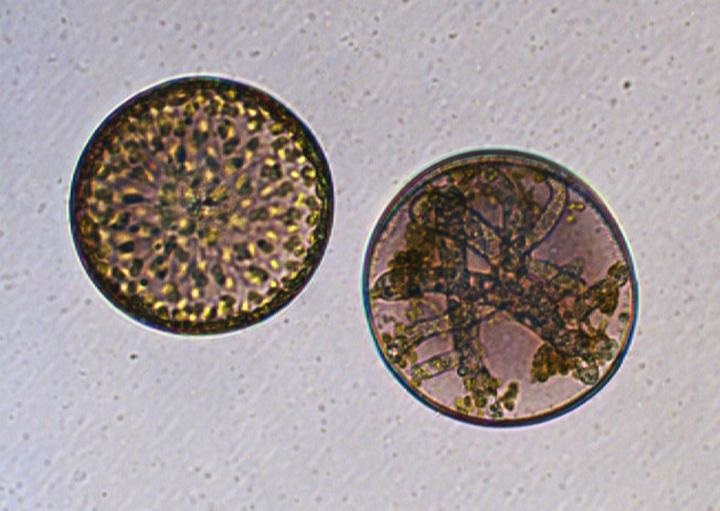
Not all diatoms are equally vulnerable to attack, so how do certain diatoms defend themselves? These and many other unresolved questions remain to be addressed in follow-up studies. The team is especially interested in identifying signaling substances involved in diatom interactions with their environment.
Image: Healthy (left) and infected (right) diatom Coscinodiscus granii: In the cell on the right, the parasitic oomycete Lagenisma coscinodisci has sucked all nutrients and modulated the algal metabolome to generate its own reproductive form, the sporangium. Image courtesy of Marine Vallet, Max Planck Institute for Chemical Ecology.