Some of the cellular and molecular processes underlying communication between gut microbes and brain cells have been described by scientists at Weill Cornell Medicine and Cornell's Ithaca campus. The study, published yesterday in Nature, used mouse models to learn about the changes that occur in brain cells when gut microbiota are depleted.
Mice treated with antibiotics to reduce their microbial populations, or that were bred to be germ-free, showed a significantly reduced ability to learn that a threatening danger was no longer present. To understand the molecular basis of this result, the scientists sequenced RNA in microglia and discovered that altered gene expression in these cells plays a role in remodeling how brain cells connect during learning processes. These changes were not found in microglia of healthy mice.
Search Antibodies Search Now Use our Antibody Search Tool to find the right antibody for your research. Filter
by Type, Application, Reactivity, Host, Clonality, Conjugate/Tag, and Isotype.
"Changes in gene expression in microglia could disrupt the pruning of synapses, the connections between brain cells, interfering with the normal formation of new connections that should occur through learning," said co-principal investigator Dr. Conor Liston.
The team also looked into chemical changes in the brain of germ-free mice and found that concentrations of several metabolites associated with human neuropsychiatric disorders such as schizophrenia and autism were changed. "Brain chemistry essentially determines how we feel and respond to our environment, and evidence is building that chemicals derived from gut microbes play a major role", said Dr. Frank Schroeder.
Next, the researchers tried to reverse the learning problems in the mice by restoring their gut microbiota at various ages from birth. "We were surprised that we could rescue learning deficits in germ-free mice, but only if we intervened right after birth, suggesting that gut microbiota signals are required very early in life," said Dr. Liston. "This was an interesting finding, given that many psychiatric conditions that are associated with autoimmune disease are associated with problems during early brain development."
"The gut-brain axis impacts every single human being, every day of their lives," said co-senior author Dr. David Artis. "We are beginning to understand more about how the gut influences diseases as diverse as autism, Parkinson's disease, post-traumatic stress disorder, and depression. Our study provides a new piece of understanding of how the mechanisms operate."
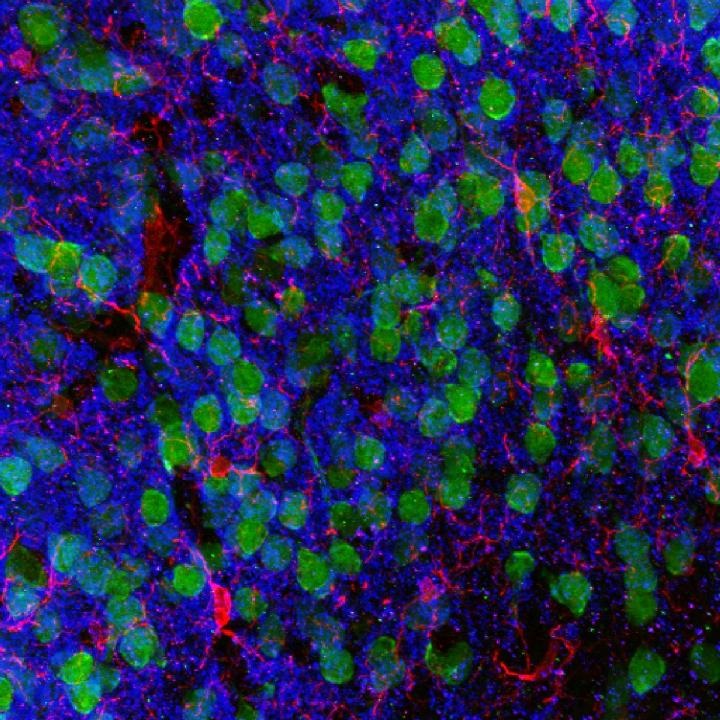
Image: Medial prefrontal cortex demonstrating cortical neurons (green), microglia (red), and the post-synaptic marker PSD95 (blue). Image courtesy of Drs. Christopher Parkhurst and David Artis.