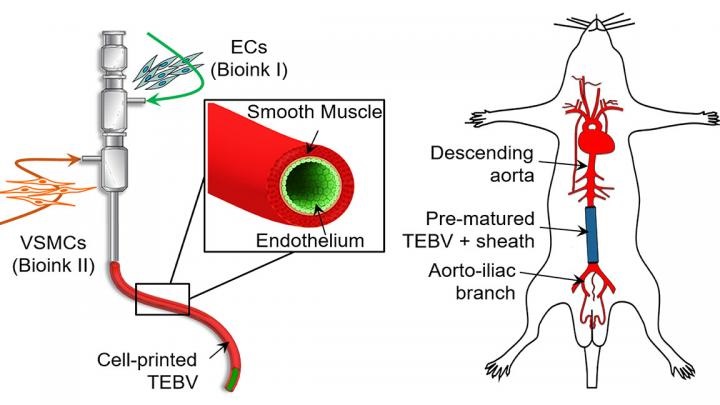
In a study published today in Applied Physics Reviews, scientists created a biomimetic blood vessel using a modified 3D cell printing technique. The technique involved the use of bioinks that were formulated from human aortal smooth muscle cells and umbilical vein endothelial cells. The vessel was fully functional, with a dual-layer architecture that outperforms existing engineered tissue.
The engineered blood vessels were grafted as abdominal aortas into six rats. Over the next several weeks, the scientists observed a transformation in which the rat’s fibroblasts formed a layer of connective tissue on the surface of the implant to integrate the fabricated vessel graft as part of the existing, living tissue.
The study also includes details on the triple-coaxial 3D printing technology that the researchers developed and their analysis of the unique architecture, physical strengths and biological activity of the engineered tissue. “The artificial blood vessel is an essential tool to save patients suffering from cardiovascular disease,” says first author Ge Gao. “There are products in clinical use made from polymers, but they don't have living cells and vascular functions. We wanted to tissue-engineer a living, functional blood vessel graft.”
Search Antibodies Search Now Use our Antibody Search Tool to find the right antibody for your research. Filter
by Type, Application, Reactivity, Host, Clonality, Conjugate/Tag, and Isotype.
Prior attempts to construct small-diameter blood vessels have yielded blood vessels that are fragile and prone to blockage. They often use a stripped-down version of extracellular material, such as collagen-based bioinks. In contrast, material from a native blood vessel contains collagen plus a collection of diverse biomolecules that provide a favorable microenvironment for vascular cell growth.
After fabrication, the printed blood vessel was matured in a lab that was designed to tune the vessel’s biological and physical characteristics to precise specifications of wall thickness, cellular alignment, burst pressure, tensile strength, and its ability to contract—mimicking natural blood vessel function.
The authors plan to continue to develop processes to increase the strength of the blood vessels closer to that of human coronary arteries. They also plan to perform long-term evaluation of vascular grafts, observing what happens as they continue to develop in place and become real tissue in the implanted environment.
Image: Researchers in Asia used triple-coaxial cell printing technology to construct biomimetic tissue-engineered blood vessels that include an endothelium layer surrounded by a smooth muscle layer. The pre-matured blood vessels were evaluated in vivo through an interpositional abdominal aorta graft in a rat model. Image courtesy of Gao et al.