While humans smell with their noses, insects such as fruit flies smell with their antennae. But that isn’t the only difference between human and insect olfaction; sense of smell also plays a fundamental role in fruit fly courtship.
In a study published today in Neuron, UCSD neurobiologists have made a series of discoveries about fruit fly olfactory processing. They even solved a long-standing puzzle concerning whether and how courtship-promoting signals are amplified by these neurons.
Nearly 10 years ago, scientists made a significant leap in characterizing insect olfaction when they identified unique properties of the receptor proteins involved. They showed that when odor particles are detected, receptors of the insect olfactory receptor neurons (ORNs) function as ion channels. But little progress has been made in understanding how the strengths of these neuronal responses are regulated.
Search Antibodies Search Now Use our Antibody Search Tool to find the right antibody for your research. Filter
by Type, Application, Reactivity, Host, Clonality, Conjugate/Tag, and Isotype.
In the current study, researchers identified the role of the PPK25 channel, which is permeable to sodium ions. They found that this channel amplifies courtship signals in the ORNs of male flies. Mechanistically, these findings draw further similarities between invertebrate olfactory neurons and vertebrate ORNs, which also undergo signal amplification. Biologically, PPK25 heightens males’ sensitivity to their mates’ odors at the age of peak fertility, thus promoting courtship when flies are most fertile.
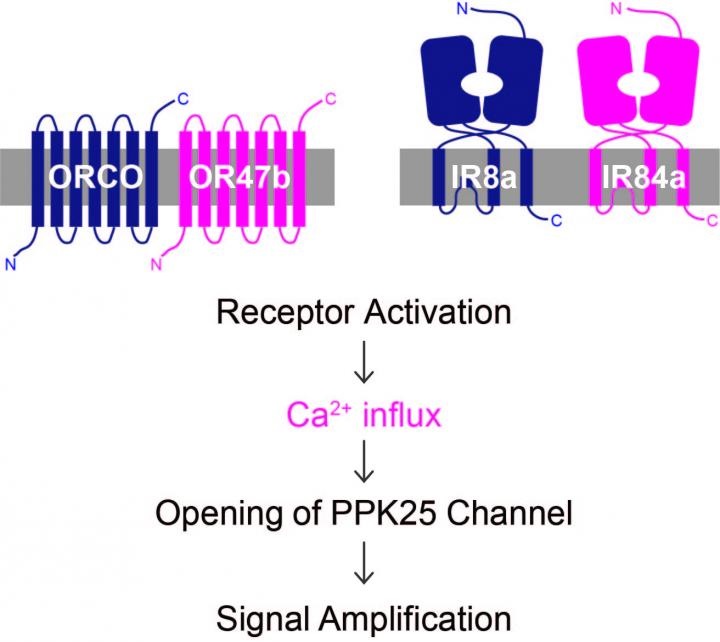
“Given its evolutionary importance, courtship behavior is under tight hormonal regulation. We find that PPK25 expression is upregulated in those neurons by a reproductive hormone,” says senior author Chih-Ying Su. “The expression level in turn determines the ORN response magnitude to impact courtship behavior. Without such amplification, male courtship is severely compromised.”
PPK25 is a member of a superfamily of ion channels that may also employ the same amplification mechanism. The study therefore carries implications across several species beyond fruit flies, including worms, mosquitoes, and even humans. In principle, the amplification mechanism unraveled in the new study could operate in other sensory modalities such as touch, temperature, and hearing.
Image: A graphical representation of how the PPK25 channel amplifies courtship signals in fruit flies. Image courtesy of Su Lab, UC San Diego.