Diminutive animals known as tardigrades appear to us as plump, squeezable toys, earning them irresistible nicknames such as “water bears” and “moss piglets.” But don’t let their squishy appearance fool you. These microscopic invertebrates are highly resilient. In fact, they’re considered extremophiles, with seemingly superpower abilities of defense in harsh conditions. Now, scientists at UCSD have gained a new understanding of how tardigrades are protected in extreme conditions. Their findings were published today in eLife.
At roughly 0.1–1 millimeter in size, tardigrades are found in water environments around the world—including mountainous, deep sea, and Antarctic environments. They are well documented as having remarkable abilities to survive extreme conditions, from dangerously high radiation levels to chillingly low temperatures to exposure to deadly chemicals. They’ve even been launched into space as part of a project to transfer life forms to the moon (and crash-landed there with the Beresheet lander spacecraft earlier this year).
Previous studies identified a protein named Dsup (Damage suppression protein) that is found only in tardigrades. Intriguingly, when Dsup is tested in human cells, it can protect them from X-rays. However, it was still not known how Dsup performs this impressive feat.
Search Antibodies Search Now Use our Antibody Search Tool to find the right antibody for your research. Filter
by Type, Application, Reactivity, Host, Clonality, Conjugate/Tag, and Isotype.
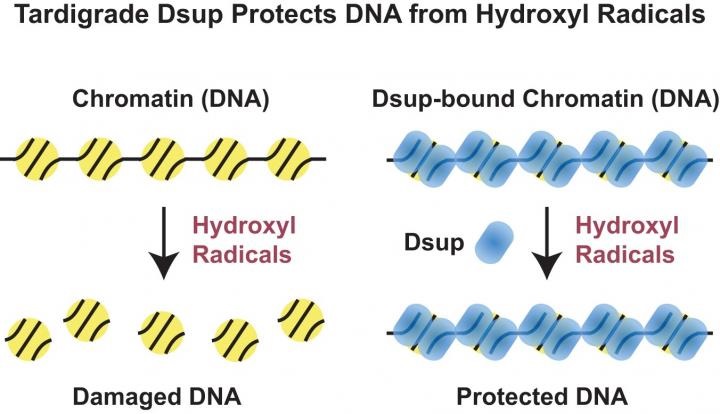
“We now have a molecular explanation for how Dsup protects cells from X-ray irradiation,” says senior author James Kadonaga. “We see that it has two parts, one piece that binds to chromatin and the rest of it forming a kind of cloud that protects the DNA from hydroxyl radicals.”
However, Kadonaga doesn’t think this protection was meant specifically to shield against radiation. Instead, it’s probably a survival mechanism against hydroxyl radicals in the mossy environments that many terrestrial tardigrades inhabit. When the moss dries up, tardigrades shift into a dormant state of dehydration, or anhydrobiosis, during which Dsup protection should help them survive.
The researchers say the new findings eventually could help researchers develop animal cells that can live longer under extreme environmental conditions. In biotechnology, this knowledge could be used to increase the durability and longevity of cells, such as for the production of some pharmaceuticals in cultured cells.
Image: UC San Diego biologists found that tardigrades, or 'water bears,' are able to withstand extreme conditions because of a Damage suppression protein (Dsup) that binds and forms a protective cloud against survival threats. Image courtesy of James Kadonaga/UC San Diego.