Researchers have built a new tool to study molecules using a laser, a crystal, and light detectors. This new technology will reveal nature’s smallest sculptures—the structures of molecules—with increased detail and specificity.
“We live in the molecular world where most things around us are made of molecules: air, foods, drinks, clothes, cells, and more. Studying molecules with our new technique could be used in medicine, pharmacy, chemistry, or other fields,” says senior author Takuro Ideguchi of the University of Tokyo.
The new technique combines two current technologies in a unique system called ‘complementary vibrational spectroscopy.’ All molecules have very small, distinctive vibrations caused by the movement of the atoms’ nuclei. Tools called spectrometers detect how those vibrations cause molecules to absorb or scatter light waves. Current spectroscopy techniques are limited by the type of light that they can measure.
Search Antibodies Search Now Use our Antibody Search Tool to find the right antibody for your research. Filter
by Type, Application, Reactivity, Host, Clonality, Conjugate/Tag, and Isotype.
The new complementary vibrational spectrometer can measure a wider spectrum of light, combining the more limited spectra of two other tools: infrared absorption and Raman scattering spectrometers. Combining the two spectroscopy techniques gives researchers different and complementary information about molecular vibrations.
“We questioned the ‘common sense’ of this field and developed something new,” Ideguchi says. “Raman and infrared spectra can now be measured simultaneously.”
Previous spectrometers could only detect light waves with lengths from 0.4 to 1 micrometer (Raman spectroscopy) or from 2.5 to 25 micrometers (infrared spectroscopy). The gap between them meant that Raman and infrared spectroscopy had to be performed separately. It’s like trying to enjoy a duet but having to listen to the two parts separately.
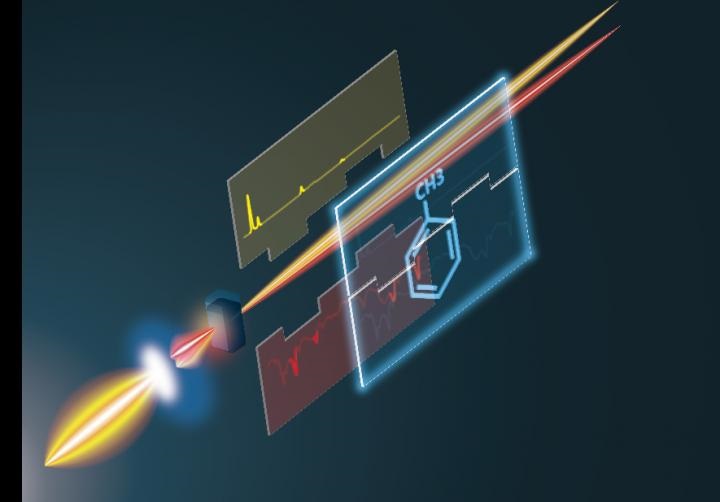
Inside the complementary vibrational spectrometer, a titanium-sapphire laser sends pulses of near-infrared light with the width of 10 femtoseconds (10 quadrillionths of a second) towards the chemical sample. Before hitting the sample, the light is focused onto a crystal of gallium selenide. The crystal generates mid-infrared light pulses. The near- and mid-infrared light pulses are then focused onto the sample, and the absorbed and scattered light waves are detected by photodetectors and converted simultaneously into Raman and infrared spectra.
So far, researchers have tested their new technique on samples of pure chemicals commonly found in science labs. They hope that the technique will one day be used to understand how molecules change shape in real time.
Image: The new technique of complementary vibrational spectroscopy relies on improvements in ultrashort pulsed laser technology. Researchers at the University of Tokyo hope to use complementary vibrational spectroscopy to see molecules change shape in real time without invasive techniques. Image courtesy of Takuro Ideguchi, CC BY-ND-4.0.