For over 50 years, it has been believed that most viruses are icosahedrons (or, in simple terms, shaped like mini footballs), however imaging advances have revealed increasing numbers of outliers. A new mathematical framework has been developed that seeks to enable a better understanding of virus architecture and subsequently new insights into how viruses form, evolve, and infect their hosts.
The theory, from researchers at the University of York and San Diego State University, was published today in Nature Communications. According to first author, Professor Reidun Twarock, "Our study represents a quantum leap forward in the field of structural virology, and closes gaps in our understanding of the structures of many viruses that are ill described by the existing framework.
Search Antibodies Search Now Use our Antibody Search Tool to find the right antibody for your research. Filter
by Type, Application, Reactivity, Host, Clonality, Conjugate/Tag, and Isotype.
"This theory will help scientists to analyse the physical properties of viruses, such as their stability, which is important for a better understanding of the mechanism of infection. Such insights can then be exploited for the development of novel anti-viral strategies. In particular the structures of larger and more complex viruses that are formed from multiple different components were previously not well understood.”
"Our over-arching scheme reveals container architectures with protein numbers that are excluded by the current framework, and thus closes the size gaps in CKT."
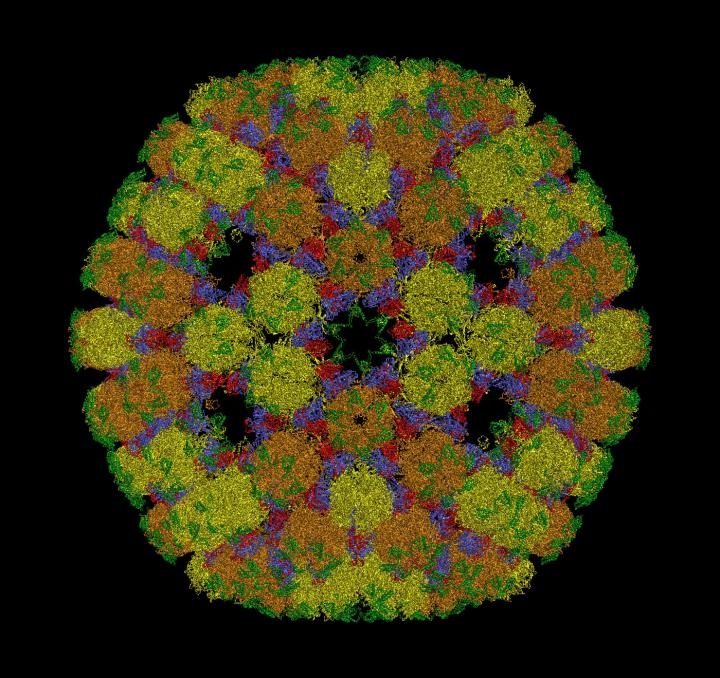
Second author, Dr Antoni Luque, adds, "We can use this discovery to target both the assembly and stability of the capsid, to either prevent the formation of the virus when it infects the host cell, or break it apart after it's formed. This could facilitate the characterization and identification of antiviral targets for viruses sharing the same icosahedral layout."
Image: The new mathematical framework changes the way we understand the structure of viruses such as Herpes. Image courtesy of Prof Reidun Twarock, University of York