Researchers have found evidence that B cells might play an important role in immunotherapy for melanoma. Immunotherapy is a form of cancer treatment that uses the body’s own immune system to recognize and fight the disease. It comes in a variety of forms, including cancer vaccines, targeted antibodies, and tumor-infecting viruses. Only some cancer patients currently benefit from this kind of therapy.
In the case of melanoma, which is a particularly aggressive form of skin cancer, established immunotherapies focus on T cells. T cells play an important role in controlling and shaping the immune system, and they are able to directly kill cancer cells while also recruiting other cells into the process.
But a study published today in Nature Communications shows that, alongside T cells, B cells, which produce antibodies and messenger molecules, play a critical role in triggering melanoma-associated inflammation. The researchers found that, in the case of melanoma, B cells direct T cells to the tumor via the secretion of distinct messenger molecules.
Search Antibodies Search Now Use our Antibody Search Tool to find the right antibody for your research. Filter
by Type, Application, Reactivity, Host, Clonality, Conjugate/Tag, and Isotype.
“Immunotherapy has transformed cancer treatment. It unleashes T cells so they can fight cancer in a more effective way,” explains first author Johannes Griss of the Medical University of Vienna and EMBL-EBI. “For the first time, we found that B cells also play an important part in the process and help T cells find the tumor. The role of B cells in immunotherapy is still largely unknown, but it seems they may have more impact than previously thought.”
During the study, the researchers observed that when B cells were depleted from melanoma patients, the number of T cells and other immune cells dramatically decreased within the tumors as well. In subsequent experiments, the researchers showed that a special subtype of B cells seems to be responsible for guiding T cells and other immune cells to the tumor. The same subtype also increased the activating effect of current immune therapies on T cells.
Interestingly, melanoma cells seem to force B cells to develop into this distinct B cell subtype. “Further research is required to answer questions such as how melanoma cells modify B cells, what mechanism B cells use to support the activation of T cells, and how we can help these B cells to support current immunotherapies in cancer patients,” Griss says.
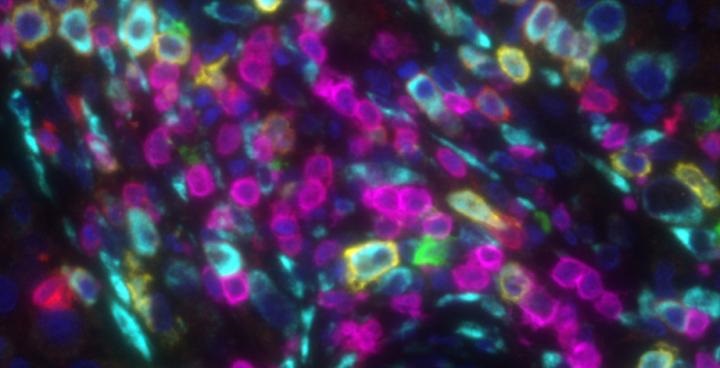
Image: Using multiplex-immunostaining to characterize B cells. Image courtesy of Christine Wagner.