PIM kinases, which are known to promote the motility and survival of cancer cells, have now been shown to also regulate the sense of smell.
"We especially wanted to study the regulation of olfactory neurons, since we had noticed that PIM kinases are expressed in the olfactory epithelium in mice. Instead of mice, however, we chose the invertebrate Caenorhabditis elegans nematode as our experimental organism," explains senior author Dr Päivi Koskinen of the University of Turku.
In her chemotactic experiments, Karunambigai Kalichamy, lead author of the paper published in eNeuro earlier this month, measured the motility of the nematodes toward or away from volatile or soluble compounds and compared untreated control animals with those treated with PIM inhibitors.
Search Antibodies Search Now Use our Antibody Search Tool to find the right antibody for your research. Filter
by Type, Application, Reactivity, Host, Clonality, Conjugate/Tag, and Isotype.
"Untreated nematodes immediately started to crawl towards attractive agents or run away from unpleasant compounds. PIM inhibitors did not affect any gustatory sensations, but significantly interfered with olfaction, so that the drug-treated animals were not able to respond to olfactory cues, but randomly moved to different directions," Kalichamy reports.
These results were not simply due to off-target effects of the drugs, as similar data were obtained also when PIM expression was abrogated by targeted mutations.
"Next it would be interesting to dissect the molecular effects of the PIM kinases in more detail and find out, whether they regulate olfaction also in humans and other mammals. The results could be interesting not only to evolution biologists, but to pharma companies, too. In case the PIM inhibitors rapidly, but luckily reversibly, reduce human olfactory responses in cancer patients, this phenomenon could even be used as a biomarker to assess the efficacy of the PIM-targeted therapies that are currently being developed against several types of cancer," adds Koskinen.
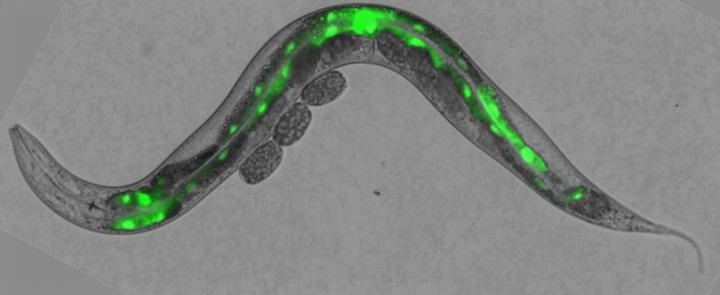
Image: An expression of fluorescently tagged PIM kinase in the nervous system and intestine of C. elegans. Image courtesy of Karunambigai Kalichamy.