The micbrobiome isn’t only important in the gut. Skin, our largest organ, also hosts a vibrant and complex microbiome, and it can also provide health insights. In a study published this week in mSystems, an international research team has developed an index to better understand skin health across human populations.
“A central goal of human microbiome projects is to diagnose and predict the human’s healthy or unhealthy state via the microbiome,” says senior author Jian Xu of the Chinese Academy of Sciences.
In the gut or the skin, the composition of microbes can indicate health and diet issues. Xu noted that by understanding the skin microbiome, researchers can also predict how the skin may react to specific treatments. The issue, though, is that skin microbiome differs between human populations due to environment, health status, body locations, diet, and other mitigating factors.
Search Antibodies Search Now Use our Antibody Search Tool to find the right antibody for your research. Filter
by Type, Application, Reactivity, Host, Clonality, Conjugate/Tag, and Isotype.
“Due to the variance, the ability to use skin microbiome as an indicator of skin health that applies across large geographic ranges has remained largely unexplored,” Xu says. “As such, the central question of this study is, can we harness the talent and power of our skin microbiome for precise skin care, such as diagnosis and treatment?”
To answer this question, the team assessed children with either healthy skin or with atopic dermatitis (eczema). Eczema affects 15–30% of children around the globe, so the researchers examined children in three different cities: Beijing and Qingdao in China and Denver, Colorado, in the United States. Qingdao is a coastal city approximately seven hours drive north of Beijing. Denver is a mountain city, with a higher elevation than the other two cities.
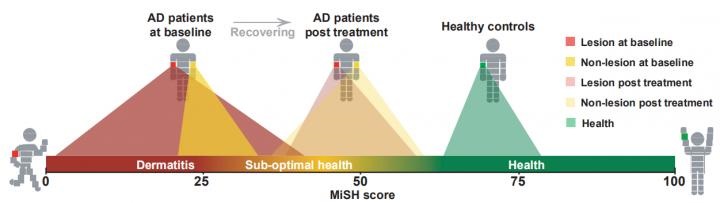
In these vastly different locations, the researchers identified 25 bacterial genera in the skin microbiomes of children, and they developed a Microbial index of Skin Health (MiSH). According to first author Zheng Sun, this index can identify skin conditions, such as eczema, and has implications in clinical settings.
“MiSH can quantitatively assess pediatric skin health across cohorts from distinct countries over large geographic distances,” Sun says. “MiSH can identify a risk-prone skin state and predict treatment effect in children, suggesting applications in patient stratification and personalized treatment in the clinics and in the skin care industry.”
Next, the researchers plan to further study the mechanisms by which the index helps predict skin health and refine how well it predicts treatment response in larger and wider cohorts.
Image: MiSH is a universal scale to quantitatively assess and compare skin-health state via skin microbiota. Image courtesy of Zheng Sun.