Sepsis occurs when the body goes overboard in its attempt to fight off an infection. Immune cells rush in, overreact, and wreak havoc on tissues and organs, often resulting in organ failure and death. Currently, sepsis is addressed by preventing and treating the source infection, often with antibiotics, while maintaining organ health with oxygen and intravenous fluids.
“Sepsis is the leading cause of death in intensive care units throughout the world, but unfortunately there is not a single approved drug treatment for sepsis,” says Victor Nizet of UCSD.
In a study published yesterday in eLife, UCSD researchers found that removing the enzyme PHLPP1 improved outcomes in a mouse model of sepsis. PHLPP1 controls many cell behaviors by removing phosphates from other proteins. And, it now turns out, PHLPP1 also influences inflammation.
Search Antibodies Search Now Use our Antibody Search Tool to find the right antibody for your research. Filter
by Type, Application, Reactivity, Host, Clonality, Conjugate/Tag, and Isotype.
“Most research on inflammation has typically focused on kinases, enzymes that add phosphate tags to other proteins,” says senior author Alexandra Newton. “It’s exciting to have a completely new target for sepsis—the enzymes that remove them.”
Newton’s team discovered PHLPP1 a few years ago and have since detailed its role in suppressing tumors. Now, the team has uncovered many immune cell genes that are influenced by PHLPP1. But PHLPP1’s particular influence on inflammation could be linked to the fact that it removes phosphates from a transcription factor called STAT1, which is known for controlling inflammatory genes.
In separate experiments, Victor Nizet’s team administered live E. coli bacteria and lipopolysaccharide (LPS), a component of the bacterium’s cell wall that drives immune systems wild, to both PHLPP1-deficient and normal mice. The difference was surprising. While all normal mice died of the infection-induced sepsis after five days, half of the PHLPP1-deficient mice survived.
The researchers had already been working to screen thousands of chemical compounds to identify those few that inhibit PHLPP1. Now that they know PHLPP1 inhibitors might form the basis for new anti-sepsis drugs, the researchers hope to test these compounds on immune cells in the lab and in the mouse model of sepsis.
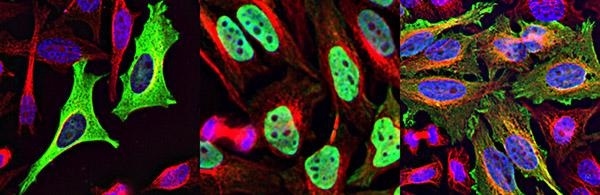
Image: HeLa cells expressing PHLPP (left), the segment with the nuclear localization signal (middle), and that same segment mutated (right). Image courtesy of UC San Diego School of Medicine.