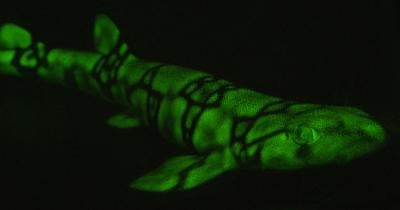
In the depths of the sea, certain shark species emanate a bright green glow that only other sharks can see. In a study published yesterday in iScience, researchers identified what’s responsible: a previously unknown family of small-molecule metabolites. The newly discovered mechanism of biofluorescence is different from that of most glow-in-the-dark marine creatures (e.g., jellyfish), and it may help sharks identify each other and fight infections.
“The exciting part of this study is the description of an entirely new form of marine biofluorescence from sharks—one that is based on brominated tryptophan-kynurenine small-molecule metabolites,” says co–corresponding author David Gruber of the City University of New York.
The team focused on two species of sharks: the swell shark and the chain catshark. Both species have two tones of skin—light and dark—and the researchers extracted chemicals from both. What they found was a fluorescent molecule that was present only in the light skin.
Search Antibodies Search Now Use our Antibody Search Tool to find the right antibody for your research. Filter
by Type, Application, Reactivity, Host, Clonality, Conjugate/Tag, and Isotype.
These types of small-molecule metabolites are known to be fluorescent and activate pathways similar to those that, in other vertebrates, play a role in the central nervous system and immune system. But in the sharks, the novel small-molecule fluorescent variants account for the biophysical and spectral properties of their lighter skin.
“It’s a completely different system for them to see each other that other animals cannot necessarily tap into. They have a completely different view of the world that they’re in because of these biofluorescent properties that their skin exhibits and that their eyes can detect,” says co–corresponding author Jason Crawford. “Imagine if I were bright green, but only you could see me as being bright green, but others could not.”
The molecules also serve other purposes, including potentially providing protection against microbial infections.
“It is also interesting that these biofluorescent molecules display antimicrobial properties. These catsharks live on the ocean bottom, yet we don’t see any biofouling or growth, so this could help explain yet another amazing feature of shark skin,” Gruber says. “This study opens new questions related to potential function of biofluorescence in central nervous system signaling, resilience to microbial infections, and photoprotection.”
While the study focused on two shark species, Gruber and Crawford hope to more broadly explore the luminescent properties of marine animals, which can ultimately lead to the development of new imaging techniques.
Image: Biofluorescent shark photographed swimming. Image courtesy of David Gruber.