Fear can be measured in the brain, and fearful, life-threatening events can leave quantifiable, long-lasting traces in the neural circuitry. These events can have enduring effects on behavior, as shown most clearly in post-traumatic stress disorder (PTSD). A Western University study published today in Scientific Reports demonstrates that fear of predators can have PTSD-like effects on prey.
The researchers experimentally demonstrated that the effects predator exposure has on the neural circuitry of fear in wild animals can persist beyond the initial ‘fight or flight’ response. In animals exposed in the interim to natural environmental and social conditions, the changes in fear circuitry can still remain measurable more than a week later.
“These results have important implications for biomedical researchers, mental health clinicians, and ecologists,” first author Liana Zanette explains. “Our findings support both the notion that PTSD is not unnatural, and that long-lasting effects of predator-induced fear with likely effects on fecundity and survival are the norm in nature.”
Search Antibodies Search Now Use our Antibody Search Tool to find the right antibody for your research. Filter
by Type, Application, Reactivity, Host, Clonality, Conjugate/Tag, and Isotype.
Retaining a powerful enduring memory of a life-threatening predator encounter could be evolutionarily beneficial if it helps the individual avoid such events in the future. In fact, a growing number of biomedical researchers are suggesting that PTSD is the cost of inheriting an evolutionarily primitive mechanism that prioritizes survival over quality of life.
However, Zanette and her collaborators have shown in a previous study that fearful parents are less able to care for their young. And the long-lasting effects of fear on the brain demonstrated in this new study suggest that predator exposure could impair parental behavior for a prolonged period with greater negative effects on offspring survival than previously envisaged.
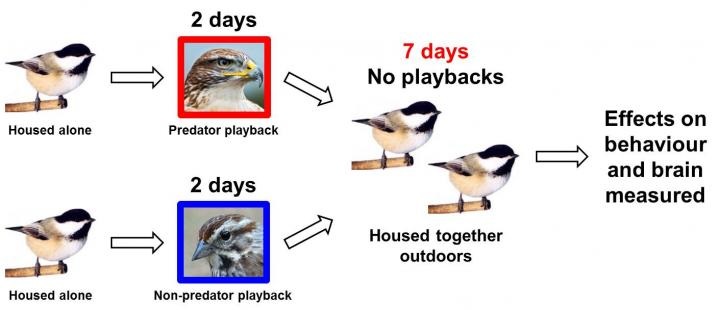
The study was conducted on wild-caught, black-capped chickadees. For two days, individual birds were exposed to audio playbacks of the vocalizations of either predators or non-predators and then housed together in flocks outdoors for seven days, during which time they were not exposed to any further experimental cues. After this seven-day period, enduringly fearful behavior was quantified by measuring each individual’s reaction to hearing a chickadee alarm call, and long-lasting effects on the neural circuitry of fear were assessed by measuring the levels of a genetic transcription factor in the amygdala and hippocampus.
Image: Long-term effects of fear on behavior and brain measured. Image courtesy of Zanette lab.