In order to sustain their rapid growth, cancer cells need to take up nutrients at a faster rate than healthy cells. In many cancer cells, the human glutamine transporter ASCT2 is upregulated, allowing more of the amino acid glutamine into the cell. Researchers at the University of Groningen have now elucidated the structure of the human ASCT2, which could potentially help with drug development. The results were published today in Nature Communications.
The research allowed the scientists to solve a long-standing riddle. It has been known that these transporters work like an elevator: The substrate glutamine is engulfed by the protein and then carried inside the cell through the cell membrane. While it was understood how the glutamine enters the “elevator” on the outside, it remained unknown what happens once it reaches the inside.
This study now shows how the transported glutamine is released into the cytoplasm of the cell. The release mechanism is surprisingly similar to its catch mechanism on the outside of the cell. The same gate—i.e., the elevator door—is used on both sides of the membrane.
Search Antibodies Search Now Use our Antibody Search Tool to find the right antibody for your research. Filter
by Type, Application, Reactivity, Host, Clonality, Conjugate/Tag, and Isotype.
“Hence, we have named the transport mechanism a ‘one-gate elevator,’ which sets it apart from the more commonly observed mechanisms that use two different gates for entry and release,” says coauthor Dirk Slotboom.
The researchers also claim that their new finding could lead to therapeutic benefits. “This observation is of great fundamental interest, but also has potential implications for drug design,” says coauthor Cristina Paulino. “A prominent consequence of the one-gate elevator mechanism is that large protein movements take place in the cell membrane during transport.”
Therefore, it is likely that lipids affect the protein’s function. Indeed, the authors found that many lipid-like molecules associated with the protein and occupy cavities on the surface. As these cavities have to be vacated for the elevator to move, small molecules that bind tightly to these sites could have a therapeutic effect.
Future studies will focus on finding and characterizing such molecules, which may lead to the development of new anticancer drugs in the near future.
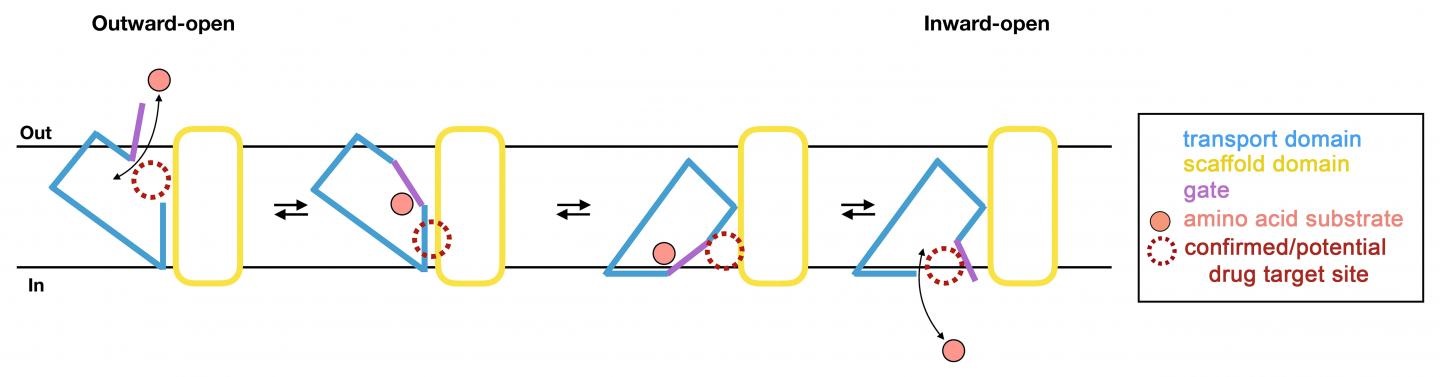
Image: A one-gate elevator mechanism for the human neutral amino acid transporter ASCT2. Image courtesy of Alisa A. Garaeva, Albert Guskov, Dirk J. Slotboom, and Cristina Paulino.