Researchers at Rice University have created soft microparticle sensors to monitor oxygen levels in tissue-engineered constructs including, potentially, engineered solid organs. A paper published earlier this week in ACS Biomaterials Science and Engineering describes their work.
"We've been collaborating with investigators in intestinal mechanobiology and wanted a straightforward way to tell what level of oxygen we had throughout our 3D tissue cultures," senior author Jane Grande-Allen said. "Where we intend a specific level of oxygen, we want to be sure that's what the cells are getting.
"There are multiple ways of doing this," she said. "We can have computational models, but we'd have to make several assumptions about the way oxygen permeates the culture medium and 3D scaffold material. A better way is to measure it directly, so that was our goal."
Search Antibodies Search Now Use our Antibody Search Tool to find the right antibody for your research. Filter
by Type, Application, Reactivity, Host, Clonality, Conjugate/Tag, and Isotype.
Lead author Reid Wilson, built on previous work to develop soft microparticles that incorporate an oxygen-triggered fluorescent molecule based on palladium and a reference fluorophore. He went through several iterations of dye combinations and concentrations to develop those microparticles. "The problem with using oxygen-responsive fluorophores in three-dimensional cultures is their signal isn’t bright enough to measure reliably," he said. "So we loaded the microparticles with high concentrations of dye, which allowed more reproducible measurements of the oxygen concentration."
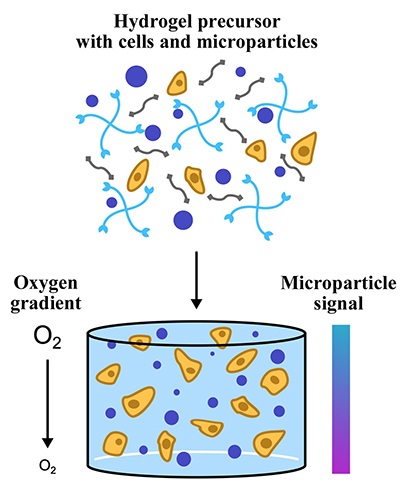
The particles can be suspended in hydrogel along with living cells, and tests showed they are not toxic to those cells. Signals from the fluorescent components can be read at their individual wavelengths, but their power lies in combining the response from both, which gives clinicians the ability to measure oxygen content as far as 2 millimeters into tissues.
Grande-Allen said the particles aren't susceptible to photobleaching when illuminated at the proper wavelength, nor did they sink out of the hydrogel, as larger fluorescent particles were prone to do, even after a year in storage.
Image: Bioengineers have developed fluorescent microparticles that can be suspended in hydrogel scaffolds seeded with live cells. The microparticles can be used to monitor for the presence of oxygen in hydrogel cultures that help injuries heal. Image courtesy of Reid Wilson/Rice University.