Using real-time, single-molecule imaging, University of Pittsburgh scientists have gotten a glimpse of how UV-DDB keeps DNA damage in check. According to a study published today in Nature Structural and Molecular Biology, UV-DDB, which stands for ultraviolet-damaged DNA-binding, is useful beyond safeguarding against the sun. This new evidence points to UV-DDB being a scout for general DNA damage and an overseer of the molecular repair crew that fixes it.
"If you're going to fix a pothole, you have to find it first. That's what UV-DDB does. It identifies DNA damage so that another crew can come in and patch and seal it," said study senior author Bennett Van Houten, Ph.D. Surveying 3 billion base pairs, packed into a nucleus just a few microns wide, is a tall order, Van Houten said. Not only is it a lot of material to search through, but it's wound up so tightly that many molecules can't access it.
When UV-DDB finds damage, it acts like a foreman to help the DNA repair crew get in, fix the faulty bases and detach quickly. Van Houten's team witnessed this activity along a "tightrope" of DNA slung between two silica beads, using real-time, single-molecule imaging.
Search Antibodies Search Now Use our Antibody Search Tool to find the right antibody for your research. Filter
by Type, Application, Reactivity, Host, Clonality, Conjugate/Tag, and Isotype.
"The amazing thing is finding those single molecules in 3D space," said study coauthor Simon Watkins, Ph.D. "[Van Houten]'s team has developed an assay that allows them to track the repair enzymes in 3D on the DNA ropes as they repair damage."
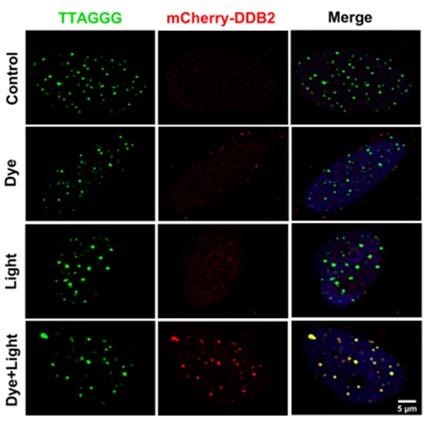
To show that UV-DDB performs the same functions in living cells, Van Houten and colleagues inflicted oxidative damage to telomeres. As in the DNA tightrope experiment, UV-DDB rushed to the scene, and when it wasn't available, cells were more sensitive to oxidative stress.
 These results help to explain why children born without functional UV-DDB, a rare disease known as xeroderma pigmentosum, are virtually guaranteed to develop skin cancer from sun exposure, Van Houten said. On the other end of the spectrum, cancer patients with higher levels of UV-DDB respond better to therapy.
Image: When telomeres (green) undergo damage (bottom row), UV-DDB (red) rushes to the scene (yellow). Image courtesy Jang et al. (2019) Nature Structural and Molecular Biology