A new study led by researchers from the University of California, Irvine, uncovers the long-sought-after 3D structure of a toxin called TcdB that is primarily responsible for the devastating Clostridium difficile infection (CDI). The study was published today in Nature Structural & Molecular Biology.
“This is the first time we could directly see the 3D structure of the gigantic TcdB holotoxin at a near-atomic resolution,” says senior author Rongsheng Jin. “Interestingly, this toxin shapes like a question mark when viewed from a certain angle, and it has been a major question for us as we seek ways to fight the toxin and CDI.”
The team also demonstrated how three antibodies could neutralize TcdB, revealing intrinsic vulnerabilities of the TcdB toxin that could be exploited to develop new therapeutics and vaccines for the treatment of CDI.
Search Antibodies Search Now Use our Antibody Search Tool to find the right antibody for your research. Filter
by Type, Application, Reactivity, Host, Clonality, Conjugate/Tag, and Isotype.
C. diff is an opportunistic pathogen that establishes in the colon when the gut microbiota are disrupted, and it is seen often in severely ill or elderly patients in hospitals or long-term care facilities. CDI has become the most common cause of antibiotic-associated diarrhea and gastroenteritis-associated death in developed countries, accounting for half-a-million cases and 29,000 deaths annually in the US. It is classified as one of the top three “urgent threats” by CDC.
The current standard of care for CDI involves treatments using broad-spectrum antibiotics that reduce the level of C. diff bacteria—but also kill the good bacteria in the gut and disrupt the normal gut microbiome. This approach leads to disease recurrence up to 35% of the time.
Recently, the FDA issued a warning about an investigational fecal microbiota for transplantation (FMT) procedure for CDI treatment following the death of a patient in a clinical trial. In another action, the FDA approved Bezlotoxumab, a TcdB-neutralizing human monoclonal antibody, as a prevention against recurrent infection.
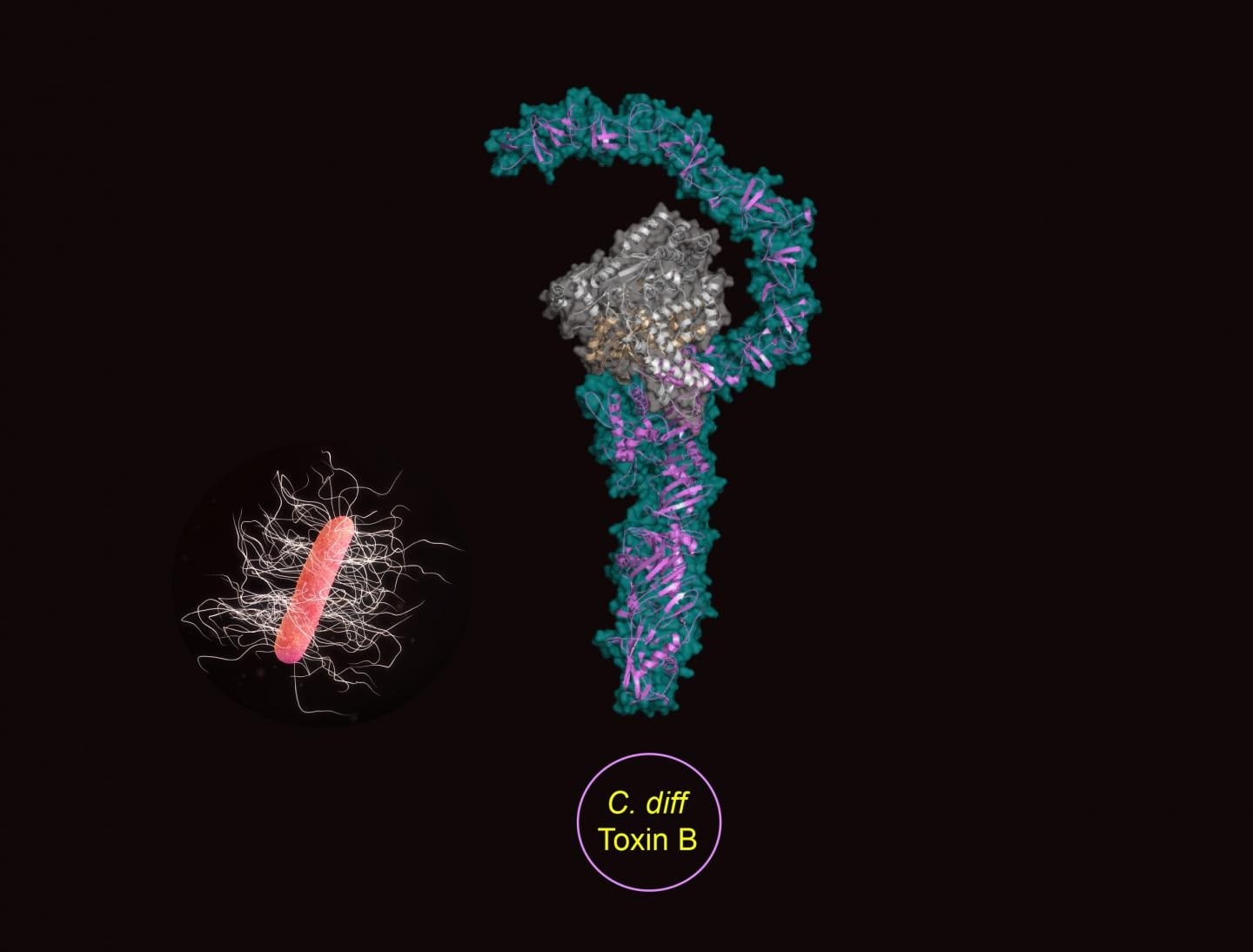
“There remains a desperate need for more potent and cost-effective therapies for CDI,” Jin says. “The good news is, the 3D structure of TcdB we have identified literally provides a blueprint for the development of next-generation vaccines and therapeutics that have enhanced potency and broad-reactivity across different C. diff strains.”
Already the UCI team is working on a novel vaccine based on the new structure. Early studies show promising results, which Jin hopes to publish soon.
Image: On the left is an illustration of the deadly C. diff bacteria as seen under a microscope. The image on the right, resembling a question mark, is the first three-dimensional crystal structure of TcdB holotoxin, secreted by C. diff. TcdB is illustrated as a ribbon model superimposed with a transparent molecular surface. This structure provides a blueprint to develop new therapeutics and vaccines for the treatment of CDI. Image courtesy of UCI School of Medicine.