Chronic itch is more than just a simple annoyance—it greatly affects quality of life. While scientists have some clues as to its causes, effective therapies have been elusive. But in a study published Wednesday in Science Translational Medicine, scientists presented a strategy that may eventually help to alleviate chronic itch.
To get their results, the researchers used a technique called quantitative high-throughput screening. This approach allowed them to sort through more than 86,000 compounds all at once, and it led them to discover that blocking a receptor found on the surface of both mouse and human spinal cord neurons could be the key.
Several years ago, the team found a receptor (called Npr1) for a protein associated with itch on mouse spinal cord neurons. When this protein bound Npr1, the itch sensation was turned on. Therefore, Npr1 looked like it could be a potential drug target to combat chronic itch.
Search Antibodies Search Now Use our Antibody Search Tool to find the right antibody for your research. Filter
by Type, Application, Reactivity, Host, Clonality, Conjugate/Tag, and Isotype.
The team now worked on identifying compounds that could block Npr1 activity. The researchers developed a series of assays and used robots to screen compounds in human cells, finding approximately 1,400 molecules worth examining more closely. They then developed additional assays to narrow that list down to 15 compounds. A subset of these compounds were able to halt both human and mouse versions of the receptor from working, and a follow-up study in mice showed that blocking the receptor reduced scratching.
The next step for the scientists is to examine more candidate compounds and determine how they block Npr1. They hope the findings will help them choose which compounds to study further and chemically modify as potential anti-itch drugs.
“This is a proof-of-concept study and an important application of what NCATS does,” says James Inglese of NCATS. “We wanted to show that by pharmacologically blocking the target receptor, the approach could be successful in finding a drug to treat chronic itch. Because it can take a long time to develop an ideal compound, the rationale behind the approach needs to be well vetted.”
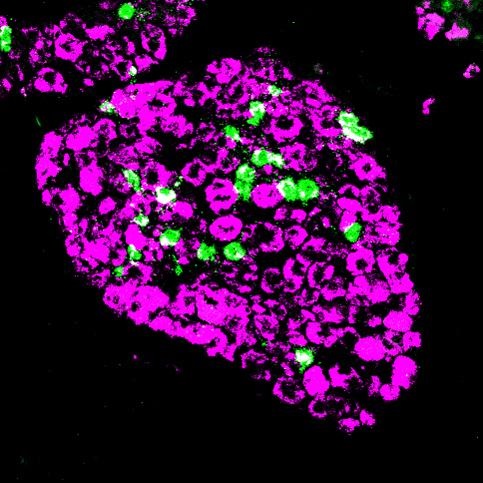
Image: Nerves that stimulate skin are grouped in structures next to the spinal cord. Here, nerves in such a structure—called a dorsal root ganglion—that are involved in detecting an itch are labeled green. Nerves involved in sensing pain, temperature, and other stimuli are shown in magenta.