Sorting through individual immune cells is a handy way to see how the body responds to disease. For years, researchers around the world have used a technique called flow cytometry to separate different types of immune cells. But occasionally, they’d see two cells stuck together as a “doublet.” Many regarded doublets as an artifact of the flow cytometry process, and it was common to dump them before gathering data.
But new research published today in eLife by scientists at the La Jolla Institute of Immunology took a closer look at doublets. The researchers report that higher levels of doublets can be found in people with severe cases of tuberculosis or dengue fever, showing that doublets are not simply technical artifacts and that scientists could study them to predict disease progression or even vaccine effectiveness.
Search Antibodies Search Now Use our Antibody Search Tool to find the right antibody for your research. Filter
by Type, Application, Reactivity, Host, Clonality, Conjugate/Tag, and Isotype.
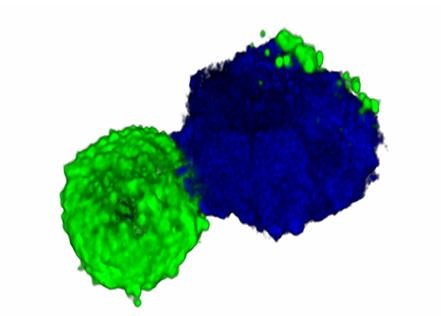
The team was inspired to investigate doublets when they ran into a puzzling group of cells in blood samples from patients with tuberculosis. Their flow cytometry experiments revealed immune cells in these patients that had the characteristics of both monocytes and T cells. High levels of these double expressors correlated with a higher risk of disease progression in the patients, and follow-up experiments showed that these cells were in reality doublets made up of a monocyte and a T cell stuck together.
The researchers then started looking for these doublets in more samples. They found that while recently infected patients tend to have more doublets, doublets appear to be surprisingly common in everyone. “Every blood sample we’ve analyzed contains doublets,” says first author Julie Burel.
The presence of doublets makes complete sense if you consider the role of T cells in the body, senior author Bjoern Peters explains. “T cells are meant to monitor what’s going on in other cells, and detect and even kill infected cells—so it makes sense to study T cells that are found in complexes with other cells.”
In tuberculosis and dengue fever, monocytes become reservoirs for disease, so T cells would be more likely to come in contact with monocytes and form doublets. And according to Peters, doublets are likely relevant in many other diseases, too. After all, infection prompts immune cells to communicate and interact more closely.
“Doublets could be a biomarker for any immune perturbation,” Burel says.
Image: This is a representative 3D-reconstructed image of a doublet of a T cell (CD3, green) and a monocyte (CD14, blue). Image courtesy of Dr. Yunmin Jung, La Jolla Institute.