USC researchers have discovered that a growth factor secreted by pericytes in the brain’s blood vessels help keep neurons alive and dementia and other diseases at bay.
Their study, which appears today in Nature Neuroscience, helps explain the cascade of problems that lead to neurodegeneration after stroke or traumatic brain injury, as well as in diseases like Alzheimer's and Parkinson's—and suggests a potential strategy for therapy.
"What this paper shows is if you lose these vascular cells, you start losing neurons. The link with neurodegeneration was really not that clear before," said senior author Berislav Zlokovic.
For this experiment in a mouse model of the human brain, Zlokovic zeroed in on pericytes in the brain's blood vessels. Pericytes help regulate blood flow and keep blood vessel walls sealed tight. When researchers artificially removed pericytes, they saw rapid degeneration of the blood-brain barrier, a slowdown of blood flow, and the loss of brain cells.
Search Antibodies Search Now Use our Antibody Search Tool to find the right antibody for your research. Filter
by Type, Application, Reactivity, Host, Clonality, Conjugate/Tag, and Isotype.
To further understand the role of pericytes, the scientists infused mice with a protein, or growth factor, secreted by pericytes in the brain and not found elsewhere in the body. They found that, even with pericyte cells artificially removed, the growth factor protected neurons and the brain cells didn't die. The results persisted even with constricted blood flow.
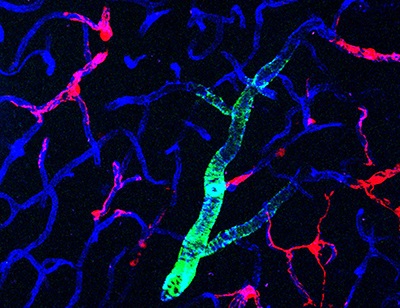
Because these pericytes are implicated in many diseases—including Huntington's, Parkinson's, stroke, brain trauma, and amyotrophic lateral sclerosis—the research offers intriguing possibilities for further investigation. "This opens up an entirely new view of the possible pathogenesis of Alzheimer's disease," Zlokovic said.
Image: Capillaries in a mouse brain. Pericytes are labeled with a fluorescent red protein. Image courtesy of A. M. Nikolakopoulou—Zlokovic Lab.