Pancreatic ductal adenocarcinoma (PDAC) is the fourth leading cause of cancer-related deaths in the world. As it is mostly chemoresistant, PDAC so far has no effective treatment. Understanding the stroma—connective tissue that surrounds, nurtures, and even protects PDAC tumors—is key to developing effective therapeutics.
“PDAC patients are diagnosed really late, so we don’t know they’re sick until the very end stages,” says first author Ela Elyada of Cold Spring Harbor Laboratory. “We can’t diagnose patients early enough because we don’t have tools, and they don’t respond to drugs. One barrier to the drugs is the fibroblasts in the stroma.”
PDAC is characterized by an abundance of non-malignant stromal cells, and fibroblasts are one of the most common types of stromal cells. “We have a lot of fibroblasts in pancreatic cancer, unlike other cancers that are mostly cancer cells,” Elyada says. These cancer-associated fibroblasts (CAFs) can help cancer cells proliferate, survive, and evade detection by the immune system.
Search Antibodies Search Now Use our Antibody Search Tool to find the right antibody for your research. Filter
by Type, Application, Reactivity, Host, Clonality, Conjugate/Tag, and Isotype.
The insidious role CAFs seem to play in protecting cancer cells labels them as bad, but completely obliterating CAFs in mice also worsened their cancers. In a study published today in Cancer Discovery, researchers investigated whether CAFs are, overall, ‘good’ or ‘bad.’ Using single-cell RNA sequencing, they classified the fibroblasts into three distinct subpopulations: two previously identified types—myofibroblastic CAFs (myCAFs) and inflammatory CAFs (iCAFs)—and also a new type called antigen-presenting CAFs (apCAFs).
While the newly identified apCAFs had the properties of fibroblasts, the researchers found that they were different from the other subpopulations. They expressed MHC class II genes, which are usually only expressed by specialized immune cells and are used to present antigens—foreign peptides—to helper T-cells. Upon detecting the antigen, the T-cell activates and recruits other immune elements to eliminate the invader.
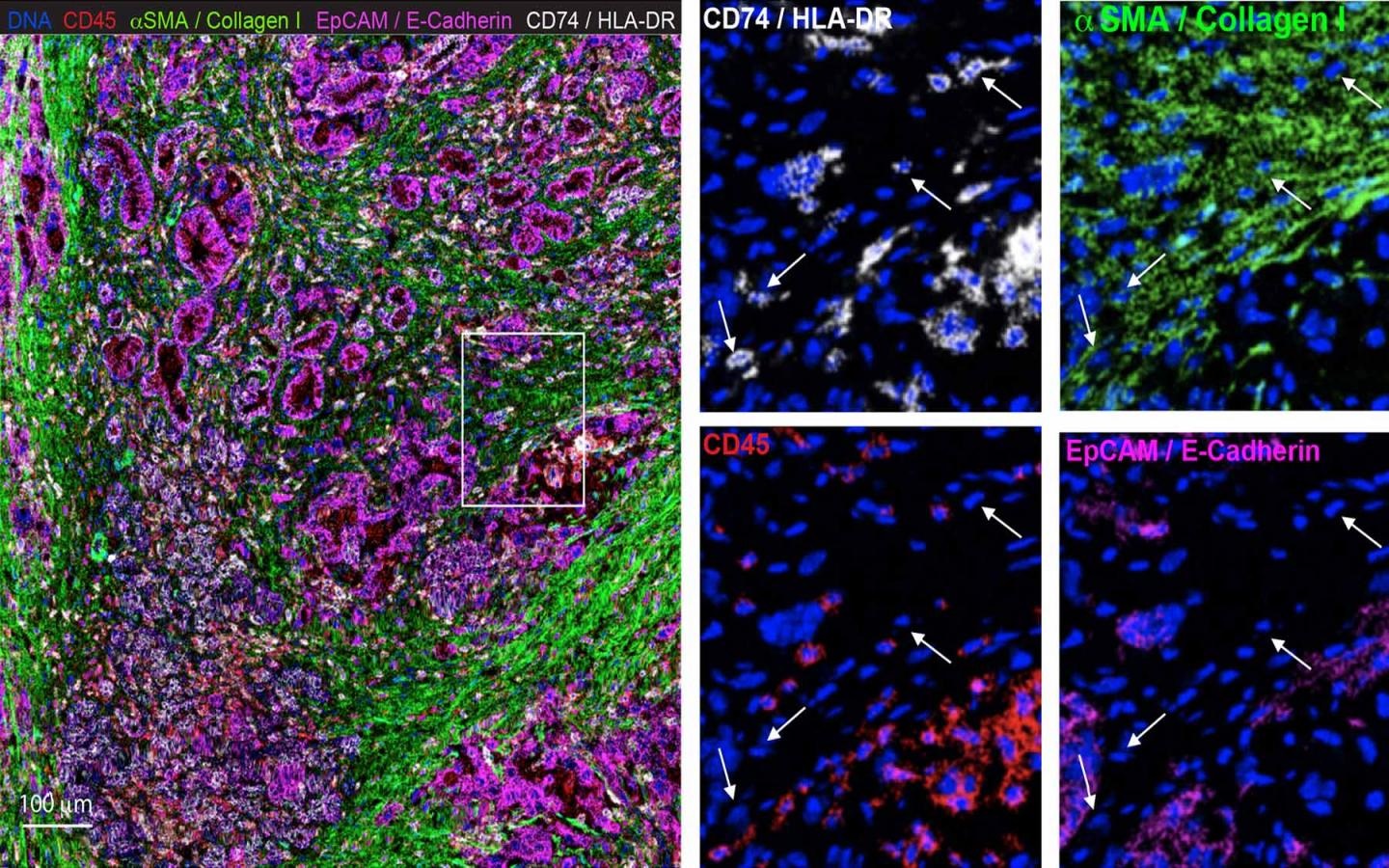
But apCAFs present in pancreatic tumors lack other components that activate T-cells. Elyada and her team hypothesize that this may result in incompletely activated T-cells that are unable to properly eliminate the cancer cells.
The research team now wants to know how the apCAFs are interacting with T-cells and the immune system. “If we can show that the apCAFs are somehow inhibiting the activity of T-cells, we can come up with therapies that specifically target that type of CAF,” Elyada proposes. “We can also combine it with other, complementary immune therapies to make them more effective.”
Image: Imaging mass cytometry (IMC) staining of a human PDAC section using metal-conjugated antibodies to mark different cell types and apCAF markers. The arrows point to examples of apCAFs in the PDAC stroma. Image courtesy of Tuveson lab/CSHL 2019.