In eukaryotic cells, the nucleus is encased by the nuclear envelope, and all transport into and out of the nucleus occurs via cylindrical channels called nuclear pore complexes (NPCs). Each NPC is made up of eight repeating protein complexes called nucleoporins (Nups). These complexes fit together like the wedges of an orange, leaving a channel in the middle through which proteins, RNA, and signaling molecules can be transported.
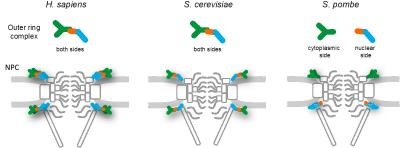
The Nups at either end of the NPC form ring-like structures that frame the openings of the channel. So far, all work in eukaryotic cells has suggested that these outer rings are identical, comprising equal numbers of nine or ten different Nups linked together in repeating Y-shaped structures. But in a study published this week in PLoS Genetics, a team led by researchers from Osaka University and National Institute of Information and Communications Technology (NICT) found that the one-size-fits-all theory might not be true.
“We wanted to take a closer look at the NPCs of fission yeast, Schizosaccharomyces pombe,” says first author Haruhiko Asakawa. “Like other eukaryotes, S. pombe has a conserved set of Nups, but unlike these other species, the outer ring structures are made up of unequal numbers of the different types of proteins.”
Search Antibodies Search Now Use our Antibody Search Tool to find the right antibody for your research. Filter
by Type, Application, Reactivity, Host, Clonality, Conjugate/Tag, and Isotype.
And while the researchers were expecting some differences, they weren’t quite prepared for the completely divergent structures revealed by using high-powered immunoelectron and fluorescence microscopes. By carefully tracking the locations of the different proteins, they made their discovery.
“It’s like S. pombe has completely thrown the rule book out the window,” notes senior author Tokuko Haraguchi. “We found that the proteins that make up the outer ring structures were arranged asymmetrically. Rather than having identical structures, the nuclear outer ring comprised only two types of Nups, with the seven remaining Nups all part of the cytoplasmic outer ring structure.”
Interestingly, the researchers found that the asymmetrical ring structure was essential for normal cell growth in S. pombe.
“This diversity in the outer ring structures may provide clues as to how the nuclear pore is formed, along with insights into the structure and function of the cell nucleus from an evolutionary point of view,” Asakawa adds. "We also hope that our findings will help us to better understand the mechanisms of diseases caused by abnormal nuclear pore proteins, which in turn may lead to new treatment strategies.”
Image: These are schematic drawings of the outer ring complex and the NPC structure in H. sapiens (left) and S. cerevisiae (middle) in comparison to that in S. pombe (right). Image courtesy of Osaka University.