UV light damages the DNA of skin cells, which can lead to skin cancer. But this process is normally counteracted by DNA repair machinery. It has been unclear, however, how repair proteins work on DNA that is tightly packed in chromatin, in which access to DNA damage is restricted by protein packaging. In a study published yesterday in Nature, researchers from the Friedrich Miescher Institute for Biomedical Research used cryo-electron microscopy to identify a mechanism that answers this question.
“In the past, nucleosomes were thought to be a major obstacle for DNA-binding proteins,” says senior author Nicolas Thomä. “In our study, we show that they are not, and that the system is tailored to bind UV lesions wherever they are.”
After UV light damages DNA, the UV-induced lesions are detected by a protein complex known as UV-DDB. Previously, it was thought that UV-DDB worked with additional proteins to shift the nucleosome in order to access these otherwise inaccessible lesions, but the new research suggests that additional proteins are not necessarily needed. Instead, the UV-DDB complex takes advantage of the intrinsic dynamics of nucleosomal DNA.
Search Antibodies Search Now Use our Antibody Search Tool to find the right antibody for your research. Filter
by Type, Application, Reactivity, Host, Clonality, Conjugate/Tag, and Isotype.
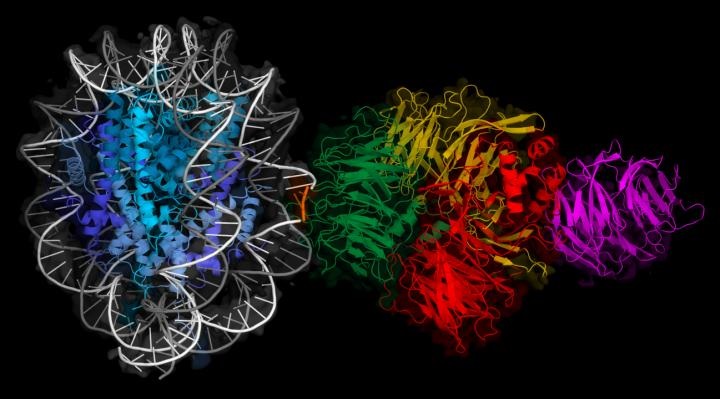
Using cryo-electron microscopy, the scientists determined the 3D structure of UV-DDB when it is bound to lesions at various locations around the nucleosome. In the case of accessible lesions, which can be directly contacted, UV-DDB binds to the lesion tightly. The recognition of occluded lesions requires additional steps: UV-DDB binds the UV lesions when they are exposed temporarily through the natural dynamics of the nucleosome.
“To visualize what happens at the molecular level, imagine a piece of string wrapped around a spool, which becomes accessible when it is pulled forwards or backwards a little bit,” explains first author Syota Matsumoto.
But the reach of the new work goes beyond DNA repair. According to Thomä, “What makes this study really powerful is the fact that the mechanism we identified could very well be used by many other types of DNA-binding proteins. Accessing nucleosomal DNA is not only fundamental for DNA repair, but is relevant for all proteins that bind to chromatin. With our study, we define a previously unknown strategy for protein access to chromatinized DNA templates.”
Image: Cryo-EM map of a molecule of UV-DDB (right) binding to DNA wrapped around a histone (left). Image courtesy of FMI.