Researchers from the University of Freiburg have discovered a cellular mechanism that solves the problem of protein highway blockades at the entrance to the mitochondria. The researchers published their findings yesterday in Nature.
Mitochondria produce the bulk of cellular energy. To function, they depend on the import of about 1,000 different proteins, which are synthesized as precursors in the cytosol. Specific protein machineries, termed protein translocases, transport these precursor proteins across the two surrounding membranes of mitochondria. The translocase of the outer membrane (TOM complex) forms the entry gate for almost all precursor proteins.
Search Antibodies Search Now Use our Antibody Search Tool to find the right antibody for your research. Filter
by Type, Application, Reactivity, Host, Clonality, Conjugate/Tag, and Isotype.
Sometimes, a small portion of the precursor proteins get stalled in the translocation channel of the TOM complex, blocking the import of further proteins into mitochondria. Impaired protein translocation into mitochondria is deleterious for the cell and leads to a number of cellular stress responses. How the cell prevents the accumulation of such clogged TOM complexes is unclear.
The researchers discovered a new mechanism that clears TOM complexes from stalled precursor proteins. They showed an interaction between the protein Ubx2 and the TOM complex. This finding was unexpected for the researchers since Ubx2 was previously found to function in the removal of misfolded proteins from the endoplasmic reticulum. The team showed that Ubx2 is also present in mitochondria, where it binds to the TOM complex to recruit the cytosolic Cdc48. Cdc48 powers the extraction of stalled precursor protein from the TOM complex and transfers it to the cellular protein degradation machinery—the proteasome.
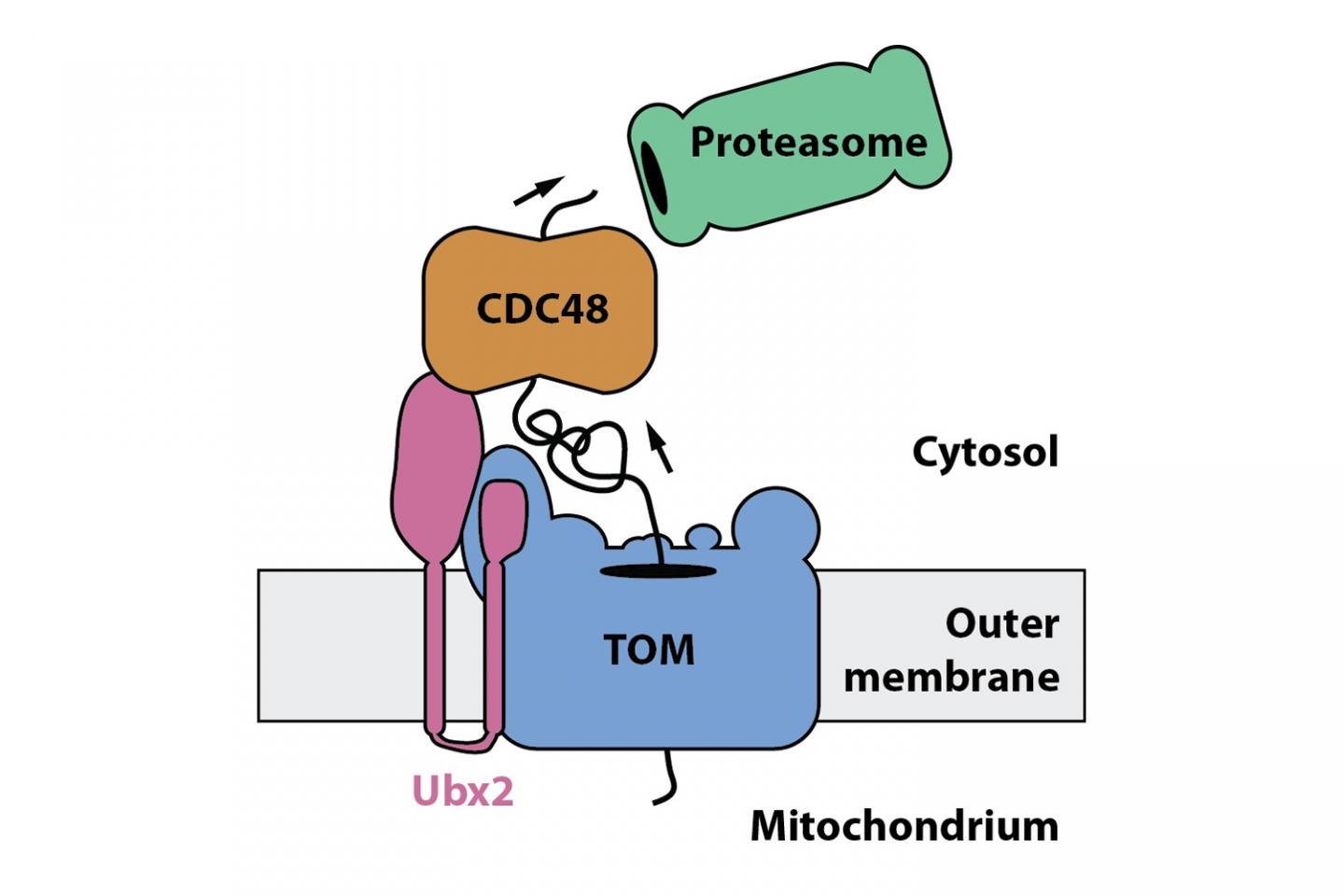
The researchers termed this pathway the ‘mitochondrial protein translocation-associated degradation,’ or mitoTAD. The mitoTAD mechanism allows efficient removal of clogged precursor proteins from the TOM complex and ensures unimpeded protein traffic into mitochondria. Since defects in protein transport into mitochondria has been linked to neurodegenerative disorders, the mitoTAD pathway could provide new insights into the molecular mechanisms that lead to the development of such diseases.
Image: Together, the proteins Ubx2 and Cdc48 promote clearance of stalled precursor proteins from the general entry gate of mitochondria, the TOM complex, for proteasomal degradation. Image courtesy of Christoph Mårtensson.