Researchers at Columbia University and the Marine Biological Laboratory (MBL) have mapped the full-body muscular activity of hydra while it was moving and behaving. According to a paper published in Current Biology today, this study adds to mounting evidence that the coordinated activity of many cells working together—in this case, across an entire organism—generates new functional and behavioral properties that are not present in single cells.
Building on their prior success in mapping full-body neural activity in Hydra, they pinpointed seven distinct patterns of muscle activity and discovered that individual muscle cells can participate in multiple patterns with different kinetics. In Hydra's muscular and nervous systems alike, these patterns appear to emerge from the coordination of many cells working in unison.
"The patterns of activation we identified were not implemented by specific, dedicated cells, but instead depended on the properties of the muscle tissue as a whole, and the interconnections between cells," says first author John Szymanski.
According to senior author Rafael Yuste, this study brings researchers a step closer to "breaking the neural code" and understanding the relationship between a stimulus and its neural response. "We are now poised to do the hard job, which is to link the activity of neurons, muscle, and behavior and decipher the neural code," Yuste says, "to explain completely how the nervous system creates behavior, at least in one animal."
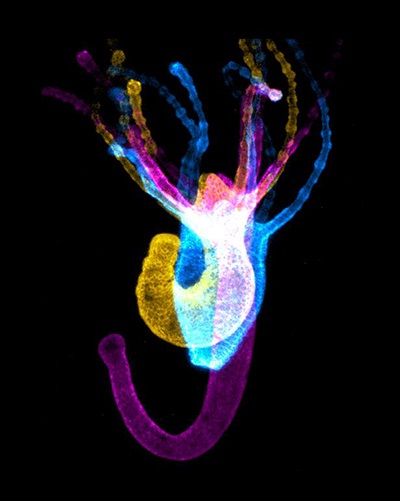
Image: Calcium imaging indicates muscular activity as Hydra vulgaris elongated (magenta), contracted (cyan) and bent (yellow). Image courtesy of John Szymanski.