Researchers from the University of California San Diego say they have identified the underlying mechanisms that control the size of cells. The discovery is a follow-on to research published five years ago. In that study, a team led by Suckjoon Jun reported that cell size is controlled by "the adder," a function that guides cells to grow by a fixed added size from birth to division.
In the research published yesterday in Current Biology, Jun, lead authors Fangwei Si and Guillaume Le Treut, and their colleagues describe the inner workings of the adder. They found that the process, also known as "size homeostasis," boils down to two required components: balanced synthesis of specific biological ingredients for cell division, including certain proteins; and a critical threshold that initiates the adder process when a sufficient number of such proteins accumulates. The adder process then follows from these two requirements, the scientists say.
"It's a very robust mechanism because each cell is guaranteed to reach its target cell size whether it is born large or small," said Jun. "The bottom line is that we found the adder is exclusively determined by some key proteins involved in cell division."
"Cell size homeostasis is a fundamental biological question and to our knowledge this is the first time we finally understand its mechanistic origin," said Jun. "We would not have been able to solve this with pure physics or pure biology. It was a very multidisciplinary approach."
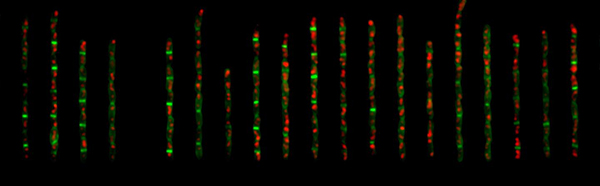
Image: E. coli cells expressing fluorescent fusion proteins of the replisome and division ring in two colors. Image courtesy of Jun Lab, UC San Diego.