Researchers at Harvard's Wyss Institute for Biologically Inspired Engineering used organ-on-a-chip technology to culture a complex human microbiome in direct contact with a vascularized human intestinal epithelium. Their anaerobic Intestine Chip stably maintained a microbial diversity similar to that in human feces, according to a study published today in Nature Biomedical Engineering.
"This new anerobic Intestine Chip technology now provides a way to study clinically relevant human host-microbiome interactions at the cellular and molecular levels under highly controlled conditions in vitro," said Donald Ingber, M.D., Ph.D. "By providing direct access to the microbiome and differentiated intestinal tissue, this method can be used to discover specific microbes or their metabolites that cause disease or that might help prevent these conditions, and because we use cells isolated from patients, this approach could be used for personalized medicine as well."
"Earlier tissue culture systems that aimed at recapitulating interactions between the human microbiome and intestinal epithelial cells in vitro were limited in their usefulness because they could not grow the two components in direct contact to one another, and did not mimic the gut's low oxygen concentrations crucial for the survival of anaerobic bacteria," said first-author Sasan Jalili-Firoozinezhad.
Search Antibodies Search Now Use our Antibody Search Tool to find the right antibody for your research. Filter
by Type, Application, Reactivity, Host, Clonality, Conjugate/Tag, and Isotype.
Intestine Chip contains two parallel microchannels separated by a porous membrane. The team grew human intestinal epithelial cells on the top of the membrane in the upper channel and vascular endothelial cells from intestinal microvessels on the opposite side of the membrane in the lower channel. The intestinal cells used to line these Intestine Chips were either from a cell line or were obtained from human ileum biopsies and expanded through an intermediate organoid step in which they formed tiny, spherical intestinal tissue structures.
To accommodate a complete microbiome, the team placed the Intestine Chips into a custom-engineered anaerobic chamber that allowed them to drastically lower oxygen concentrations in the upper intestinal epithelial channel, while maintaining the lower endothelial channel at normal oxygen concentrations. "We generated an oxygen gradient across the two channels that still allows the intestinal epithelium to be supported with oxygen diffusing through the porous membrane," said co-first author Elizabeth Calamari. "In addition, we fitted the Intestine Chips with optical sensors that can report local oxygen concentrations in both channels in real-time without disturbing the oxygen gradient."
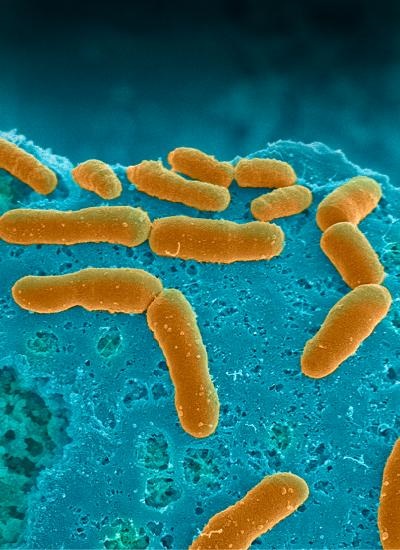
Complex gut microbiome samples either obtained from healthy human stool and stably cultured in gnotobiotic mice or freshly isolated from infant stool, were then injected into the upper epithelial channel, where they came into direct contact with the mucus layer naturally secreted by the underlying intestinal epithelium. More importantly, the diversity of the commensal bacterial populations, when grown under these low-oxygen conditions, maintained the richness observed in human intestine. "We showed through genome analysis we could culture over 200 distinct groups of bacteria for several days with abundances and ratios of obligate anaerobic bacteria similar to those observed in human stool," said Jalili-Firoozinezhad. "Importantly, the complete microbiome further enhanced the barrier function of the intestinal epithelium with its cells providing a tight seal and producing a protective mucus layer, which is an important prerequisite for intestinal health."
Image: Bacteria of the human gut microbiome (yellow) are populating the intestinal epithelial channel of the anaerobic Intestine Chip that maintains gut-like low-oxygen concentrations. The bacteria are directly attaching to a dense mucus layer produced by the intestinal epithelium. Image courtesy of Wyss Institute at Harvard University.