Scientists at the La Jolla Institute for Immunology have discovered that delivering an HIV vaccine in small doses over a series of days leads to a stronger immune response than when the same vaccine is given all at once. The study was published today in Cell.
The new strategy hinges on immune cell teamwork. When you get sick, cells that make antibodies—B cells—move to sites in your lymph nodes, called germinal centers. The B cells that express antibodies with the potential to bind to the pathogen are selected for survival by T follicular helper (TFH) cells. B cells that make the most promising antibodies then advance to further rounds of mutation, testing, and antibody refinement.
“It’s like physical training—you start off weak and then keep going back to the gym to get stronger,” says first author Kimberly Cirelli. “The germinal center is the gym and the B cells have to repeatedly go back to undergo rounds of selection to get better binding.”
Search Antibodies Search Now Use our Antibody Search Tool to find the right antibody for your research. Filter
by Type, Application, Reactivity, Host, Clonality, Conjugate/Tag, and Isotype.
To beat HIV, B cells generate antibodies that bind to the machinery on the virus that launches the infection. But HIV is a tough opponent—its outer protein shell that can be recognized by antibodies is littered with decoy sites that confuse the immune system. B and TFH cells work toward targeting the decoy sites, not realizing that the antibodies will fail.
“The vast majority of antibodies just bind the wrong places on the virus—so they’re useless,” senior author Shane Crotty says.
The researchers tested three immunization strategies: a traditional vaccine, where the vaccine was delivered with one big shot; an ‘osmotic pump’ strategy, where an implant slowly delivered the vaccine; and an escalating dose strategy, where the animals were given partial doses of the vaccine every other day for 12 days.
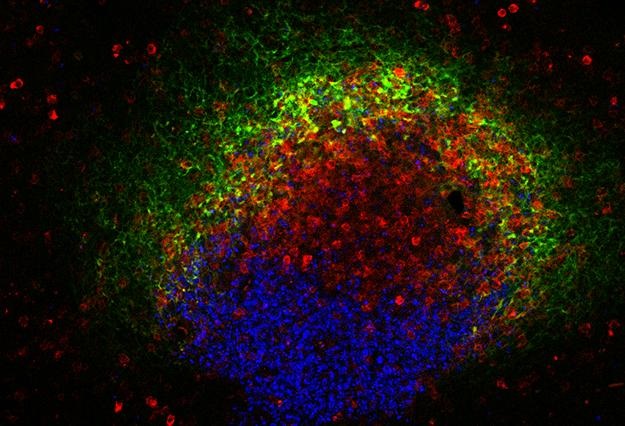
As Crotty puts it, the traditional vaccine led to a predictably “lousy” immune response dominated by non-neutralizing antibodies. But to everyone’s surprise, the two slow-release strategies led to not only more antibodies but better antibodies. The slow-release strategies appeared to keep more B cells activated for longer, giving them time to work with TFH cells and refine antibody strength and binding. As time went on, these B cells actually began producing neutralizing antibodies that could bind to important parts of HIV’s structure.
Image: Follicular dendritic cells (red) present HIV envelope protein to germinal center B cells (blue) within lymph nodes. This interaction allows the B cells to develop better antibodies against Env. Image courtesy of Dr. Jacob T. Martin, Koch Institute for Integrative Cancer Research, MIT.