Using atomic force microscopy, scientists from University College London filmed the immune system in action and discovered a key bottleneck in the process that helps to protect cells. Thieir findings, published today in Nature Communications, provide insight into how the immune system kills bacteria and why our own cells remain intact.
In earlier research, the scientists imaged the hallmarks of attack in live bacteria, showing that the immune system response results in 'bullet holes' spread across the cell envelopes of bacteria. The holes are incredibly small with a diameter of just 10 nanometers. For this study, the researchers mimicked how these deadly holes are formed by the membrane attack complex (MAC) using a model bacterial surface. By tracking each step of the process, they found that shortly after each hole started to form, the process stalled, offering a reprise for the body's own cells.
"It appears as if these nanomachines wait a moment, allowing their potential victim to intervene in case it is one of the body's own cells instead of an invading bug, before they deal the killer blow," explained Dr. Edward Parsons, first author of the paper. The team says the process pauses as 18 copies of the same protein are needed to complete a hole. Initially, there's only one copy that inserts into the bacterial surface, after which the other copies of the protein slot into place much more rapidly.
Search Antibodies Search Now Use our Antibody Search Tool to find the right antibody for your research. Filter
by Type, Application, Reactivity, Host, Clonality, Conjugate/Tag, and Isotype.
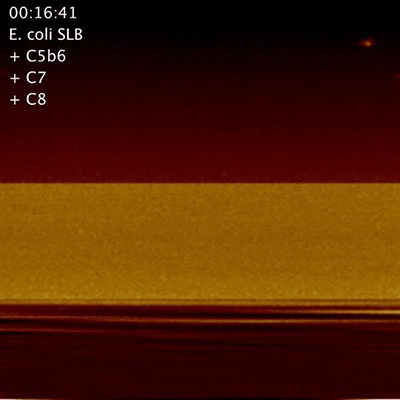
"It is the insertion of the first protein of the membrane attack complex which causes the bottleneck in the killing process. Curiously, it coincides with the point where hole formation is prevented on our own healthy cells, thus leaving them undamaged," said Professor Bart Hoogenboom, senior author.
The team believes their findings may guide the development of new therapies that harness the immune system against bacterial infections, and strategies that repurpose the immune system to act against other rogue cells in the body.
Image: Holes are formed by the membrane attack complex. Image courtesy of Edward S. Parsons et al. UCL.