Researchers from the International Peanut Genome Initiative have mapped the entire peanut genome and identified one of the crop's wild ancestors and the novel mechanism by which the shy, seed-hoarding plant generated the diversity we see today. The team's findings were published today in Nature Genetics.
"Because of its complex genetic structure sequencing peanut was only possible using very recent developments in sequencing technology. The result is of unprecedented quality, and provides a reference framework for breeding and improvement of the peanut crop, and a whole new set of insights into the extraordinary genetic structure of peanut," said David Bertioli, from the University of Georgia.
Search Antibodies Search Now Use our Antibody Search Tool to find the right antibody for your research. Filter
by Type, Application, Reactivity, Host, Clonality, Conjugate/Tag, and Isotype.
Despite their importance as a crop, plant researchers haven't had many of the genetic tools needed to speed the introduction of more sustainable and productive peanut varieties. That was because, until recently, scientists had been unable to map the peanuts' hypercomplex tetraploid genome. The Peanut Genome Initiative's international collaboration and advancements in technologies and data processing yielded the breakthroughs.
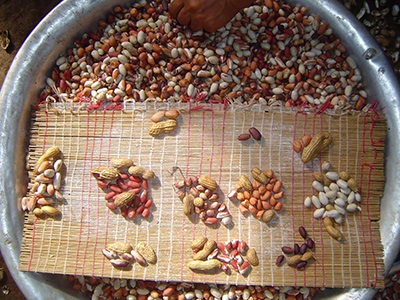
Image: While Americans are familiar with one or two varieties of peanut, farmers in other parts of the world have been able to develop hundreds of varieties thanks to the peanut's natural ability to shuffle its two distinct subgenomes to produce new traits. These are some of the peanuts grown by the Caiabí people who live on the Ilha Grande, Mato Grosso, Brazil. Image courtesy of Fábio de Oliveira Freitas.