In late March 2019, the WHO and a vaccine advisory committee of the FDA selected the final influenza strains to include in the vaccines produced for the next flu season. These include H1N1, influenza B, and H3N2 viruses. The goal is to find the best match between the vaccine and the influenza strains that are most likely to be circulating in the environment.
One common problem, however, is that the viruses chosen for vaccines often mutate during production, creating mismatches between seasonal flu viruses and the vaccine created. This has been a particular problem with H3N2 viruses. But a new technology may make H3N2 vaccine development easier. In a paper published today in Nature Microbiology, researchers describe a new cell line that enables better growth of H3N2 and reduced likelihood of mutation.
Search Antibodies Search Now Use our Antibody Search Tool to find the right antibody for your research. Filter
by Type, Application, Reactivity, Host, Clonality, Conjugate/Tag, and Isotype.
While influenza viruses used for vaccines are usually grown in eggs, some are grown in specific cell lines such as MDCK (Madin-Darby canine kidney). But H3N2 is different. “H3N2 viruses—the most important human viruses among the four strains circulating—do not grow well in eggs or even in MDCK cells, which are most commonly used for influenza virus propagation,” says senior author Yoshihiro Kawaoka of UW–Madison. “H3N2 causes epidemics more often and causes more severe disease in humans.”
Flu viruses infect cells by attaching to docking stations called receptors on the cell surface. These receptors are slightly different across species, which can affect how well an influenza virus attaches to and makes copies of itself inside cells.
In a previous study, Kawaoka’s team modified MDCK cells to include more humanlike receptors. These cells, called AX4, better supported the growth of influenza. However, H3N2 viruses acquire mutations in these cells, too. For the new study, the team modified MDCK cells by overexpressing human virus receptors and reducing avian virus receptors by using the gene-editing tool CRISPR-Cas9. They found that these cells, which they call hCK, better mimic those found in the human upper respiratory tract.
The researchers also learned that H3N2 viruses grow faster and in higher amounts in hCK cells compared to MDCK and AX4, and in the new cell line, the team could more reliably recover virus particles that came from patient samples. Importantly, the H3N2 viruses were also far less likely to mutate in regions of the virus important to its function in vaccines.
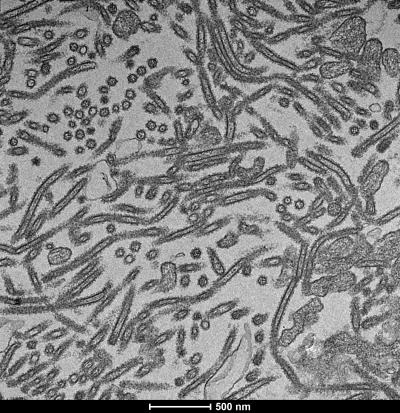
Image: An image of H3N2 viruses. H3N2 is a strain of influenza that commonly makes people sick during flu season and can cause more severe disease than other strains. Image courtesy of Yoshihiro Kawaoka, UW–Madison.