New research might explain why sometimes we can’t stop eating tasty food even though we are full. According to scientists at the University of North Carolina, a network of cellular communication emanating from the central amygdala motivated mice to keep eating calorie-rich food even though their basic energy needs had been met.
The existence of this mammalian brain circuit, described today in a paper in Neuron, might help explain why humans so often overeat. The circuit is a byproduct of evolution, when large calorie-rich meals were scarce, and so our brains were wired to devour as many calories as humanly possible because no one knew when the next super meal would come.
"This circuit seems to be the brain's way of telling you that if something tastes really good, then it's worth whatever price you're paying to get to it, so don't stop," Thomas Kash, Ph.D., explained.
Search Antibodies Search Now Use our Antibody Search Tool to find the right antibody for your research. Filter
by Type, Application, Reactivity, Host, Clonality, Conjugate/Tag, and Isotype.
Scientists in search of anti-obesity remedies have spent decades researching and targeting brain cells and circuits involved in ordinary, "homeostatic" feeding, which is triggered by hunger and keeps our energy level up. But this approach has had limited success. More recently, some scientists have been studying "hedonic" feeding—the pleasure-driven eating of calorie-rich food that tends to go way beyond our strict energy needs.
Experiments in the past few years have suggested that our wiring for hedonic feeding involves nociceptin, a small protein that works as a signaling molecule in the mammalian nervous system. Kash's laboratory and other groups have found that compounds blocking nociceptin activity—called nociceptin receptor antagonists—have little or no effect on homeostatic feeding by lab rats and mice, but these compounds do curb hedonic binging on tasty, calorie-rich foods. Thus, drug developers have eyed these antagonists as potential anti-obesity, anti-binge-eating drugs, and researchers have been eager to identify the specific brain circuits through which they work.
Identifying this circuit is largely what Kash and colleagues accomplished in their study. They engineered mice to produce a fluorescent molecule along with nociceptin, literally illuminating the cells that drive nociceptin circuits. There are multiple nociceptin circuits in the brain, but Kash and colleagues observed that one in particular became active when the mice got a chance to binge on calorie-rich food. The circuit projects to different parts of the brain, including those known to regulate feeding. It starts in the central amygdala, the emotion-processing region of the brain.
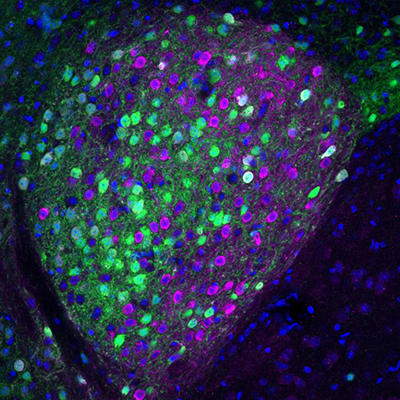
Deleting about half of the nociceptin-making neurons in this circuit reduced the mice's binging and kept their weight down when they had access to rich food, without affecting their intake of ordinary chow. Kash and his team are now studying how this circuit works, the timing of its activity in relation to feeding and other factors, and how nociceptin antagonists alter its functions.
Image: Mouse central amygdala containing prepronociceptin (green) and PKC delta (magenta) neurons. Image courtesy of Andrew Hardaway.