Deubiquitinases, enzymes that can reverse ubiquitination, have emerged in recent years as promising cancer drug targets. A study, published in Molecular Cell yesterday, looked at the differential oligomerization of two deubiquitinases in order to provide insights into their structure and function to facilitate the development of new and highly specific anticancer drugs.
The study focused specifically on the deubiquitinases USP25 and USP28. Both enzymes are important for the progression of various types of tumors. Using X-ray crystallography, a team from the Rudolf Virchow Center of the University of Würzburg was able to solve the three-dimensional structure of the central catalytic domains of the closely related enzymes.
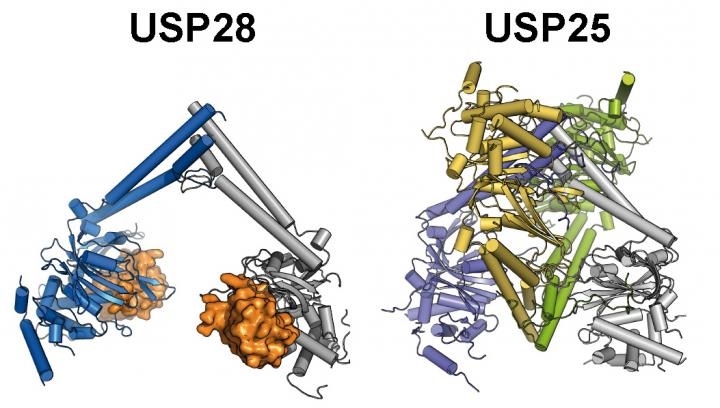
"It was surprising to discover that USP25, despite its structural similarity to USP28, is inactive in the isolated form (in vitro) as well as in cells (in vivo), and that there is a correlation between the oligomeric state and its activity," said Dr. Florian Sauer. The researchers' analysis showed that the inactive USP25 forms a tetramer. In contrast, USP28 exists as a constitutively active dimer. "By inserting alterations, found in cancer cells, we were able to show that the USP25 tetramer dissociates into two USP28-like dimers, thereby abolishing the auto-inhibition of the enzyme," reported structural biologist Theresa Klemm.
Search Antibodies Search Now Use our Antibody Search Tool to find the right antibody for your research. Filter
by Type, Application, Reactivity, Host, Clonality, Conjugate/Tag, and Isotype.
According to the team, the insights from this study will facilitate the development of new drugs, with a low risk of side-effects. "On the one hand, new approaches have been identified that could, for example, be used to develop tailor-made drugs targeting specifically USP28, thereby preventing inhibition of USP25, which is important for the immune response," says Sauer. "On the other hand, specific targeting of the already per se inhibited USP25 seems feasible by preventing its activation," Klemm added.
Image: Structures of the catalytic domains of USP28 and USP25: USP28 is a constitutively active dimer and can bind and process ubiquitin (orange) at any time. In contrast, USP25 is a tetramer composed of two inter-linked USP28-like dimers (blue / gray and yellow / green) and this arrangement prevents binding of the substrate rendering the enzyme inactive. Image courtesy of Rudolf Virchow Center of Experimental Biomedicine.