A team of engineers at the University of California, Berkeley and the Keck Graduate Institute combined CRISPR with electronic transistors made from graphene to create a new hand-held device that can detect specific genetic mutations in a matter of minutes. Their device is described in a paper published today in Nature Biomedical Engineering.
The device, dubbed CRISPR-Chip, could be used to rapidly diagnose genetic diseases or to evaluate the accuracy of gene-editing techniques. The team used the device to identify genetic mutations in DNA samples from Duchenne muscular dystrophy patients.
"We have developed the first transistor that uses CRISPR to search your genome for potential mutations," said Kiana Aran, an assistant professor at KGI. "You just put your purified DNA sample on the chip, allow CRISPR to do the search and the graphene transistor reports the result of this search in minutes."
Search Antibodies Search Now Use our Antibody Search Tool to find the right antibody for your research. Filter
by Type, Application, Reactivity, Host, Clonality, Conjugate/Tag, and Isotype.
CRISPR-Chip uses nanoelectronics to detect genetic mutations in DNA samples without first amplifying or replicating the DNA segment of interest millions of times over with PCR. This means it could be used to perform genetic testing in a doctor's office or field work setting without having to send a sample off to a lab.
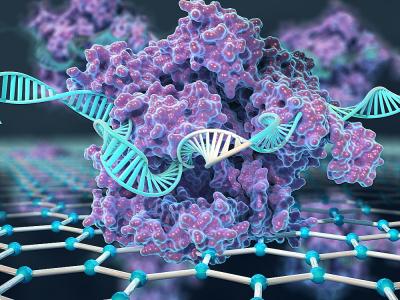
"CRISPR-Chip has the benefit that it is really point of care, it is one of the few things where you could really do it at the bedside if you had a good DNA sample," said Niren Murthy, professor of bioengineering at UC Berkeley and co-author of the paper. "Ultimately, you just need to take a person's cells, extract the DNA and mix it with the CRISPR-Chip and you will be able to tell if a certain DNA sequence is there or not. That could potentially lead to a true bedside assay for DNA."
Image: CRISPR-Chip uses deactivated CRISPR-Cas9 protein, tethered to a transistor made of graphene, to detect specific genetic sequences in a DNA sample.Image courtesy Kiana Aran.