Throughout evolution, sleep has remained universal and essential to all organisms with a nervous system. But why do humans “waste” a third of their lives sleeping? In a study published today in Nature Communications, researchers at Bar-Ilan University in Israel reveal a novel and unexpected function of sleep that they believe could explain how sleep and sleep disturbances affect brain performance, aging, and various brain disorders.
Using 3D time-lapse imaging techniques in live zebrafish, the researchers were able to define sleep in single-chromosome resolution and show, for the first time, that single neurons require sleep in order to perform nuclear maintenance. The current study shows that during wakefulness, when chromosome dynamics are low, DNA damage consistently accumulates and can reach unsafe levels. Senior author Lior Appelbaum calls the accumulation of DNA damage the “price of wakefulness.”
The role of sleep is to increase chromosome dynamics and normalize the levels of DNA damage in each single neuron. Apparently, this DNA maintenance process is not efficient enough during the online wakefulness period and requires an offline sleep period with reduced input to the brain in order to occur.
Search Antibodies Search Now Use our Antibody Search Tool to find the right antibody for your research. Filter
by Type, Application, Reactivity, Host, Clonality, Conjugate/Tag, and Isotype.
“It’s like potholes in the road,” Appelbaum says. “Roads accumulate wear and tear, especially during daytime rush hours, and it is most convenient and efficient to fix them at night when there is light traffic.”
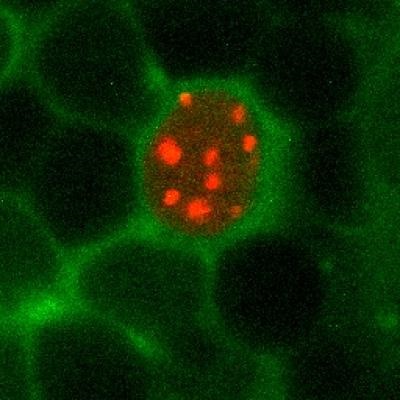
As zebrafish are transparent and have brains that are very similar to human brains, they are a perfect organism in which to study single cells within a live animal. Using a high-resolution microscope, the scientist could observe the movement of DNA and nuclear proteins within a cell inside the fish. Their results establish chromosome dynamics as a potential marker for defining single sleeping cells and propose that the restorative function of sleep is nuclear maintenance.
“Despite the risk of reduced awareness to the environment, animals—ranging from jellyfish to zebrafish to humans—have to sleep to allow their neurons to perform efficient DNA maintenance, and this is possibly the reason why sleep has evolved and is so conserved in the animal kingdom,” Appelbaum concludes.
Image: Simultaneous imaging of chromosome dynamics (red) and neuronal activity (green) in live zebrafish. Image courtesy of David Zada.