When DNA in the cell nucleus gets damaged, our cells can undergo a variety of repair mechanisms. In a study published this week in Nature Cell Biology, scientists elucidate the molecular basis by which a cell chooses between these repair mechanisms. According to the authors, this study opens up new possibilities for cancer therapies in the future.
What genes are active depends majorly on proteins called histones. “Histones are proteins around which our DNA is wrapped and which thus serve to package the genetic material,” says corresponding author Till Bartke, of Helmholtz Zentrum München. “Depending on how the histones are chemically modified, they can have different effects on the DNA and control gene activity.”
To investigate how this ‘histone code’ works, the researchers reconstruct known chemical histone modifications in a test tube and investigate which proteins selectively bind to them in an extract made from the nuclei of cells. “Put simply, we build a molecular bait with defined histones and use it to go fishing in the nucleus—and then it gets exciting to see what we will have on our ‘hook’,’” says Bartke.
Search Antibodies Search Now Use our Antibody Search Tool to find the right antibody for your research. Filter
by Type, Application, Reactivity, Host, Clonality, Conjugate/Tag, and Isotype.
Bartke and his team used this method to search for proteins that bind to newly formed chromatin. “The idea was to identify proteins that are able to differentiate between old and new chromatin and that, therefore, have a function in the replication and repair of DNA,” Bartke says.
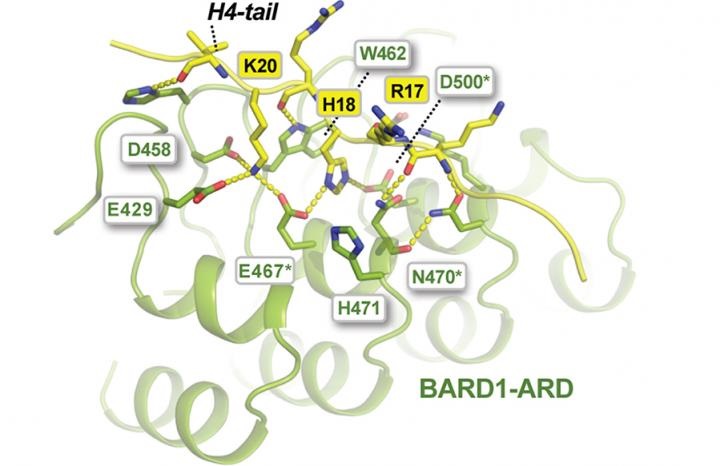
In further investigations, University of Copenhagen researchers elucidated in detail which proteins and structural elements participate in the cell’s decision about which of the different DNA repair mechanisms to initiate. The key element in this repair process is an enzyme complex associated with Breast Cancer 1 (BRCA1).
“Carriers of mutations in the BRCA1 gene have an increased risk of developing breast or ovarian cancer because their DNA damage repair system is faulty, and this, in consequence, can lead to an accumulation of further harmful mutations. However, cancer patients who carry mutations in the BRCA1 gene can be treated with PARP inhibitors, a class of drugs that are particularly effective in these patients,” says Bartke.
Finally, scientists at Oxford specifically investigated the effects of mutations in the BRCA1 complex, focusing on the part responsible for the recognition of the newly formed chromatin. When this region was inactivated in cells, the cells could be killed very effectively by a PARP inhibitor.
Image: The choice between the repair mechanisms is made at the molecule BARD1. Image courtesy of Helmholtz Zentrum München.