A research team at the University of Louisville has discovered that an immune checkpoint molecule developed for cancer immunotherapy also protects against future development of multiple types of cancer. The study was published today in Cancer Research.
The recombinant protein molecule SA-4-1BBL has been used to enhance the therapeutic efficacy of cancer vaccines by boosting the effectiveness of CD8+ T cells—adaptive immune cells trained to target the tumor for destruction. Surprisingly, when the researchers treated normal healthy mice with SA-4-1BBL alone, the mice were protected when the researchers later exposed them to different types of tumor cells.
“The novelty we are reporting is the ability of this molecule to generate an immune response that patrols the body for the presence of rare tumor cells and to eliminate cancer before it takes hold in the body,” says senior author Haval Shirwan. “Generally, the immune system will need to be exposed to the tumor, recognize the tumor as dangerous, and then generate an adaptive and tumor-specific response to eliminate the tumor that it recognizes. Thus, our new finding is very surprising because the immune system has not seen a tumor, so the response is not to the presence of a tumor.”
Search Antibodies Search Now Use our Antibody Search Tool to find the right antibody for your research. Filter
by Type, Application, Reactivity, Host, Clonality, Conjugate/Tag, and Isotype.
The researchers have determined that the molecule generates a tumor immune surveillance system through activation of what are known as CD4+ T cells and innate NK cells, thereby protecting the mice against various cancer types they have never had. This function is an indication of the molecule’s effectiveness in cancer immunoprevention. Additional testing showed that CD8+ T cells were not required for protection, indicating that the process is not one of conventional acquired immunity.
“We are very excited about the cancer immunoprevention possibilities of this molecule. Its effectiveness is not tumor specific, and as a natural ligand, it does not cause toxicity, as is found with 4-1BB agonist antibodies. Plus, the fear of autoimmunity is highly minimized, as evident from our data, because it is activating the innate immune cells,” says co-author Esma Yolcu.
Shirwan stresses that designing clinical trials based on immunoprevention is tricky, but the researchers have a plan. “With advances in cancer screening technologies and genetic tools to identify high-risk individuals, we ultimately are hoping to have the opportunity to test the SA-4-1BBL molecule for immunoprevention in individuals who are predisposed to certain cancers, as well as in the presence of precancerous lesions.”
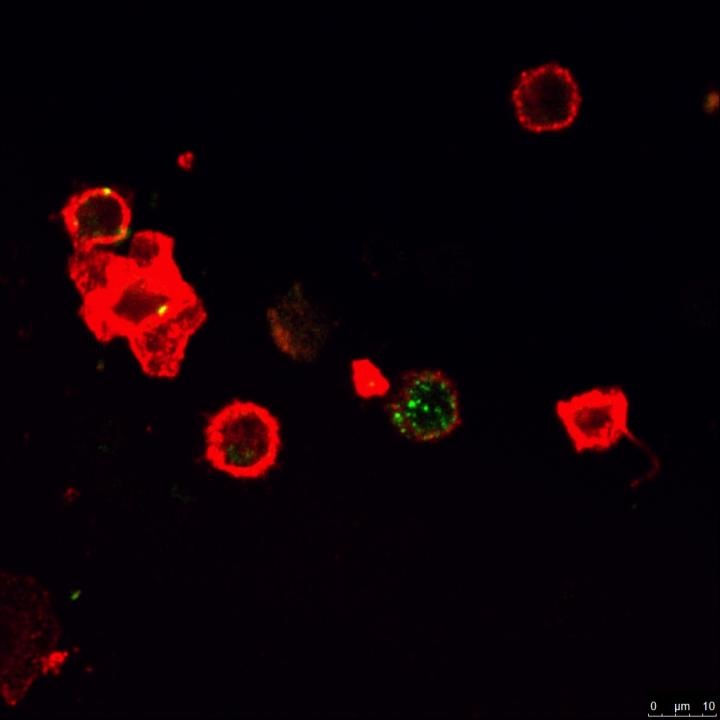
Image: A confocal microscope image shows the SA-4-1BBL (green color) bound to its receptor on an immune cell (red color) to initiate an immune activation cascade to fight cancer. Image courtesy of University of Louisville.