Cellular death is vital for health. Without it, we could develop autoimmune diseases or cancers. But a cell’s decision to self-destruct is tightly regulated so that it only happens when necessary. Now researchers have discovered a novel role for a signaling molecule that was once considered a dispensable player, a discovery that could inform fields of research as diverse as cancer, autoimmunity, and in-utero development. The research was published today in Nature Communications.
Years ago, researchers discovered receptors on the surfaces of cells they called “death receptors.” When stimulated, these receptors would send the cell into a cascade of cellular reactions that ended in death. Soon after, three molecules were discovered that contained “death domains”—areas that directly interacted with the death receptors to initiate the cascade.
Search Antibodies Search Now Use our Antibody Search Tool to find the right antibody for your research. Filter
by Type, Application, Reactivity, Host, Clonality, Conjugate/Tag, and Isotype.
Of the three major death-relaying molecules, RIPK1, FADD, and TRADD, it seemed that TRADD was the least essential. Without FADD, mice died in utero. Without RIPK1, mice died shortly before or after birth. Without TRADD, mice seemed to do just fine. TRADD had a death domain—it clearly was connected to cell-death pathways—but its main purpose was unclear.
Senior author Jianke Zhang, PhD, a Professor of Microbiology and Immunology at Jefferson, has been studying cell-death pathways for decades. Through the work of Zhang and others, it became clear that the role of these molecules wasn’t simply to turn on the death signal. Rather, in certain combinations, they could protect a cell from death rather than spur suicide.
In the present paper, the researchers showed that TRADD serves a dual function. In cells lacking the RIPK1 protein, having two copies or no copies of the gene TRADD would result in cell death. On the other hand, when only one copy of TRADD gene was present in cells lacking RIPK1, the cells tended to turn off the death signal and promote cell survival.
“The work sheds new light on the regulation of cell death and survival,” Zhang says. “In certain contexts, such as in cells that have naturally low RIPK1 expression, TRADD could drive death or promote survival.”
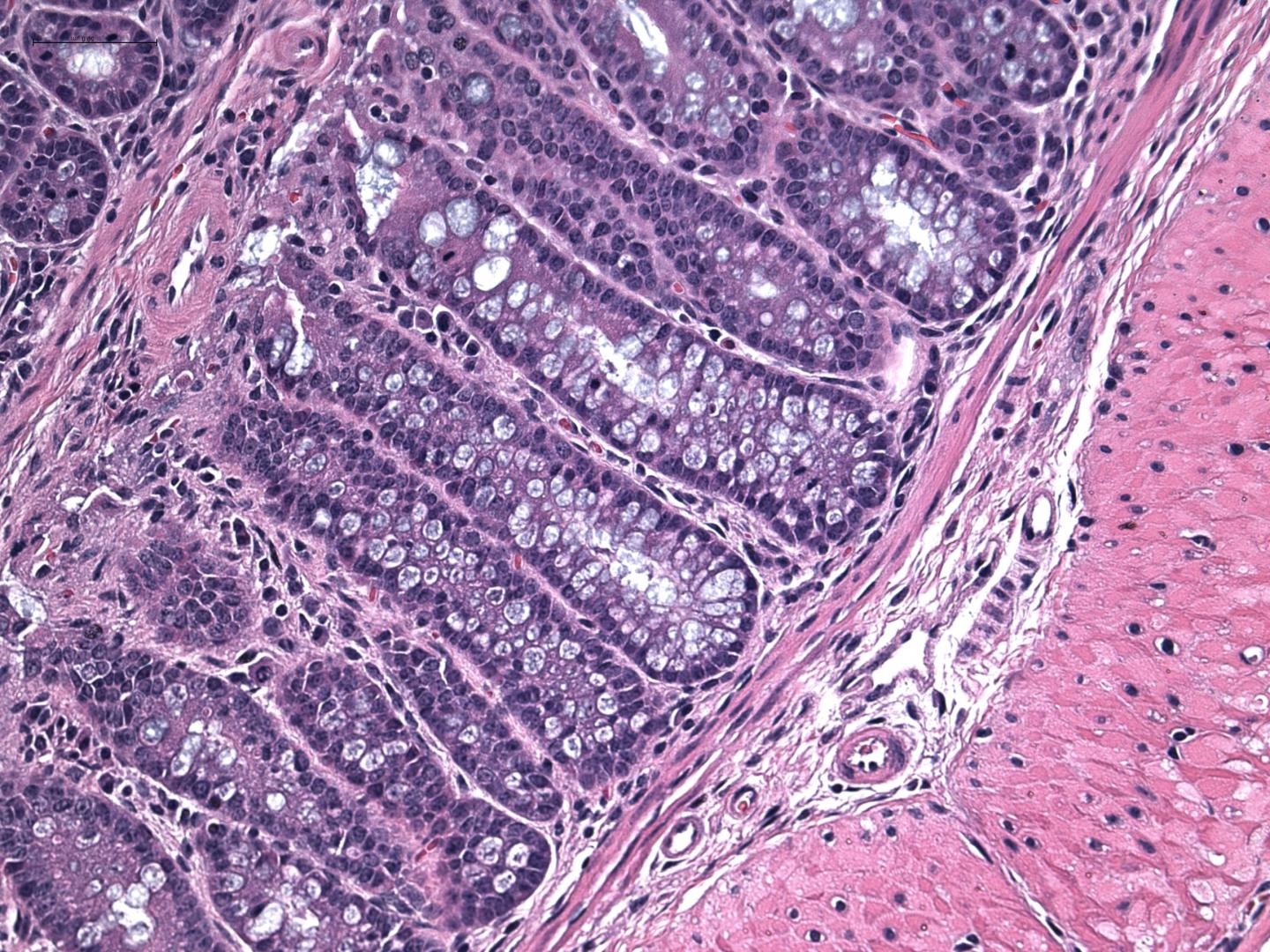
Image: Shown here, cross section of gut of normal mice. Researchers examined the gut of mice lacking TRADD and RIP and saw severe inflammation from dying cells. Image courtesy of John Dowling, Jefferson (Philadelphia University + Thomas Jefferson University).