Researchers have discovered a protective mechanism that is used by the body to protect intestinal stem cells from turning cancerous. Their study, published yesterday in Nature, demonstrates that DNA repair in the intestine is enhanced by the immune system.
The cells of our intestinal walls come into direct contact with materials from the outside. This contact is important, as many environmental factors—such as certain types of bacteria and essential nutrients—are beneficial to our health. However, environmental contact can also have a negative impact: Certain foreign substances, for instance, can trigger genetic changes inside the epithelial cells that line our intestinal walls. The accumulation of this type of DNA damage can lead to bowel cancer.
To prevent the progression to cancer, cells have the capacity to repair DNA damage and to undergo apoptosis—essentially, “cell suicide”—when the damage is too extensive. Until now, scientists have assumed that stem cells triggered this repair mechanism independently. However, the present study comes to a different conclusion—that the immune system is capable of enhancing the DNA repair mechanism in damaged stem cells, thus preventing the progression to bowel cancer.
Search Antibodies Search Now Use our Antibody Search Tool to find the right antibody for your research. Filter
by Type, Application, Reactivity, Host, Clonality, Conjugate/Tag, and Isotype.
The researchers were able to show in a mouse model that cells of the innate immune system are capable of recognizing genotoxic environmental factors present in the bowel. Among these are certain glucosinolates—natural components of plants that are commonly found in many types of cabbage. Once the cells of the innate immune system detect damaging glucosinolates, they release the cellular messenger interleukin 22. This, in turn, enables the epithelial stem cells to detect potential DNA damage earlier and repair it faster.
“The immune system acts like a sensor that detects genotoxic food components,” says senior author Andreas Diefenbach of Charité – Universitätsmedizin Berlin. “Switching off this sensor results in a significant increase in cases of bowel cancer.”
According to Diefenbach, these findings are not only evidence of a previously unknown regulatory system that is used by the body to protect itself against bowel cancer but also evidence of the fact that the immune system’s functions are far more complex than that of a simple defense mechanism against pathogens. “The immune system monitors both the healthy growth and function of different organs in the body,” Diefenbach explains.
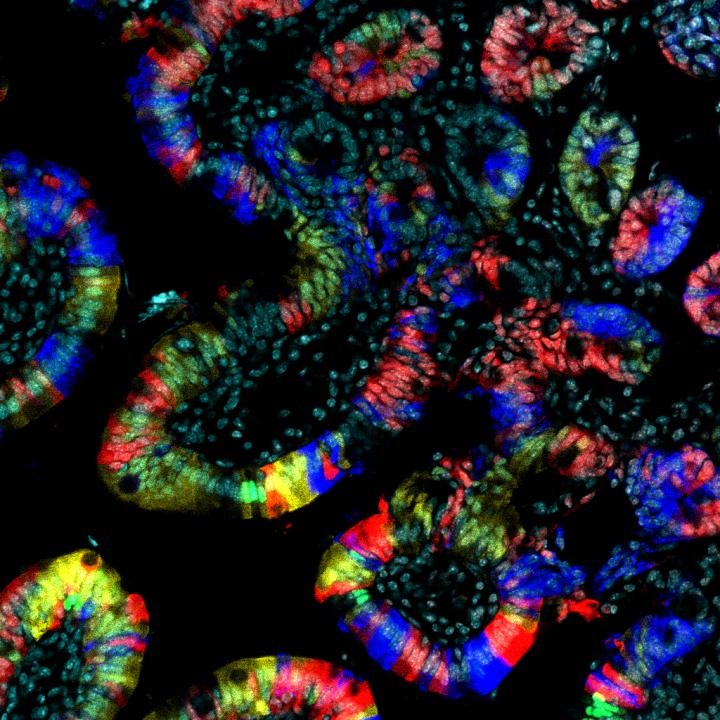
Image: The intestine in cross-section. The uppermost cell layer of the intestinal wall, visualized using different fluorescent proteins (mouse model). Image courtesy of Diefenbach/Charité.