Therapeutics capable of stopping amyotrophic lateral sclerosis (ALS) in its tracks are urgently needed. Researchers from Scripps Research say they may have found such a compound that blocks the most common genetic cause of both familial ALS and frontotemporal dementia and describe it in a recently published paper in Cell Chemical Biology.
According to Matthew Disney, Ph.D., the compound works differently than most drugs on the market. Rather than binding with the toxic protein behind the disease, it binds with what's involved in making the protein, a specific form of RNA folded over like a hairpin. Since RNA molecules manage the expression of genes, intervening at the RNA level goes right to the apparent cause of that form of the disease, Disney says.
"There are zero therapies that address the root cause of this disease," Disney says. "Zero. Our goal is not to target the symptoms, it is to target the root cause, which is that RNA."
There are likely multiple causes of ALS. For an estimated 1 in 10 people with ALS, it runs in the family. Around a third of them appear to have inherited the type of DNA damage that Disney's compound targets.
The damaged DNA lies in a non-coding section of the 9th chromosome. There, a stutter-like repeat of letters GGGGCC prompt the cell's protein building machinery to start production of a toxic substance, C9RAN, which appears to disrupt the nerve cell's normal metabolism, leading to its death, Disney says.
It is the death of the nerve connectors between muscles and the brain that leads to ALS symptoms of muscle atrophy, weakness, and difficulty swallowing and breathing. In frontotemporal dementia, the toxic protein appears to be a cause of neuron death in parts of the brain that control behavior and personality, the frontal and temporal lobes.
One important finding of the paper is that the form of the RNA being targeted by many research groups at present may not actually be the one driving neuron death, Disney says. "There are two different shapes of the protein. The data supports that the shape people have not been looking at is actually the toxic one," he adds.
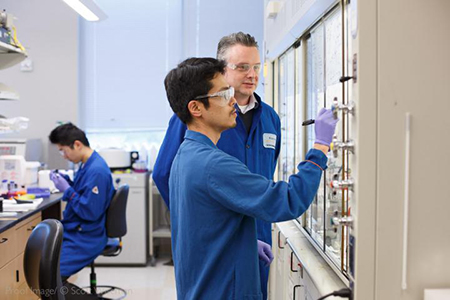
Image: Scripps Research Chemistry Professor Matthew Disney goes over a formula in his lab. His group at Scripps Research in Jupiter, Florida has made a potential drug that stops ALS, in early studies.